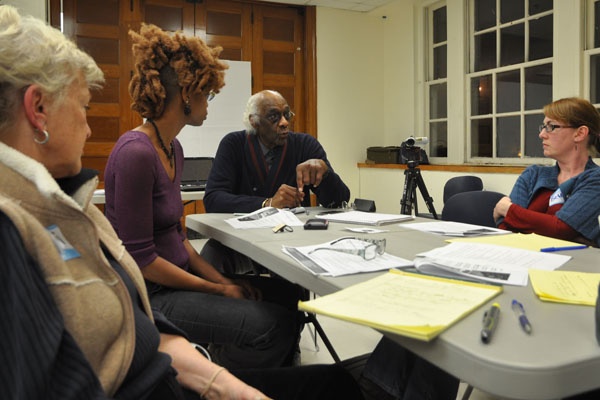
Germantown United CDC is participating in Philly.com’s Street Level series, part of The Next Mayor project.
The series focuses on specific issues pertinent to a particular community as addressed by local leaders and asks how the next mayor of Philadelphia can help.
Our question is pretty simple – Why are there zero public trash cans for roughly a mile stretch on Germantown Ave, between Penn and Berkley streets, an area that houses numerous storefronts and is serviced by the SEPTA 23 bus route at every block?
FOR IMMEDIATE RELEASE: Councilwoman Bass uses NTI Funds to Support the YWCA
As the Councilwoman for the 8th district it is my job to advocate for every neighborhood, keeping in mind the unique perspectives of residents while recognizing community treasures.
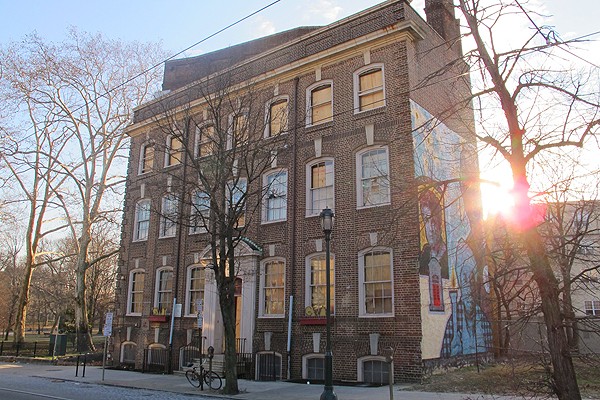
When I took office in 2012, the question of what to do about the YWCA loomed large, as this building is an integral part of the neighborhood’s history. And while we are still working towards a final answer, I am beyond pleased that we have endeavored to explore additional options. I am most impressed with the creativity of the ideas that have been presented thus far, and nothing less should be expected in and for Germantown.
While we await the Request for Proposals (“RFP”) to be issued by the Pennsylvania Redevelopment Authority (“PRA”) this Spring, I will continue to speak with local developers and discuss their bold and unique visions for Germantown. Some of the concepts suggested thus far include full market-rate condominiums and/or rental units, office space, retail options and recreation uses. These suggestions have been presented both individually and in various combinations, and I am excited about the possibilities ahead. We are seeking developers that have the capacity to move quickly, who have a plan to involve the community in the process, and who take into account the importance of environmental sustainability. The RFP will be an open and transparent process, with an emphasis on preservation.
But beyond what goes into the YWCA, we must address the building’s condition and the recent concerns brought forward at a community meeting around this topic back in January. As rumors began flying about the building’s condition, (i.e., instability), it was critical that we operated on the facts. Working with the Department of Licenses and Inspection, and private consultants including former L & I Commissioner Bennett Levin, we got those facts which I am pleased to report.
I am happy to announce the YWCA is not imminently dangerous, and I have committed $2.2 million of my Neighborhood Transformation Initiative (“NTI”) funds to rehab the property and make the building safe and stable. With additional funds from the PRA, totaling approximately $4 million, we are able to provide the resources to protect and weatherize the property to prevent the building from any further structural deterioration. We will also be able to provide the much needed ‘curb appeal’ to make the property more marketable, and aid in stabilizing the commercial corridor.
We have to be thoughtful and deliberate about development in Germantown-just as we have in Mt. Airy and Chestnut Hill. Nothing less will be acceptable. With the NTI funds I am committing to this project, it will help make the site more attractive to developers while protecting a vital part of our City’s history. The building is currently in poor condition, but with our subsidy from NTI and the PRA, it will be saved and developed.
Germantown United CDC gets tough love from community rejuvenators
MARCH 1, 2012 | By AMY Z. QUINN
Photos Courtesy of WHYY
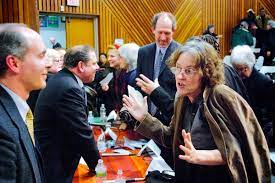
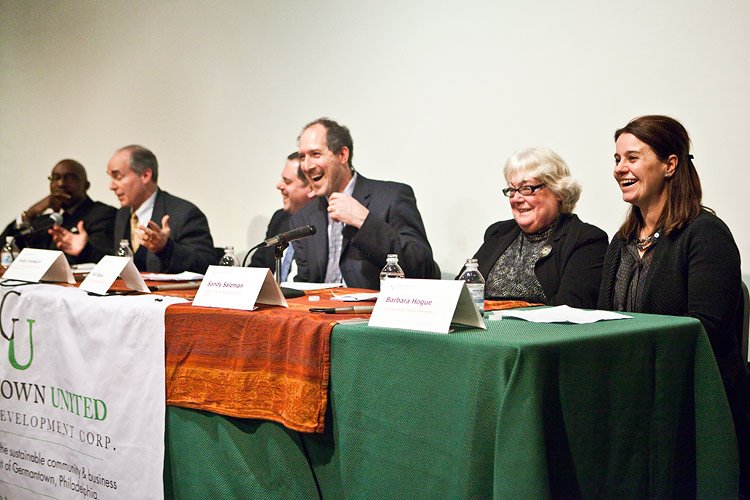
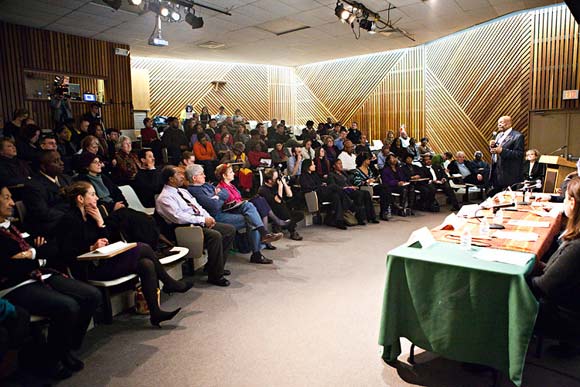
The community development experts who came to Northwest Philadelphia on Wednesday to meet with Germantown United Community Development Corp. and offer advice didn’t pull any punches in talking about the challenges ahead.
Everyone in the community won’t agree with what you’re doing — and they don’t have to, one advised.
Be willing to go to great lengths to get people involved — even if it means sometimes playing on their fears, another said.
Understand that gentrification will mean that some people will leave — and that’s not always a bad thing, yet another said.
And most of all, they offered, be ready to fight against low expectations — from within and without.
“People have low expectations, and it gives them an excuse not to engage,” said Colvin W. Grannum, president of the Bedford-Stuyvesant Restoration Corp., which began revitalization efforts in New York City in 1967.
Similar challenges
At the panel discussion, held on the Germantown Friends School campus, Grannum talked about some of the challenges the nation’s first community development corporation has faced in the 45 years since it was started by U.S. Senators Robert F. Kennedy and Jacob Javits.
While Bed-Stuy had riots that touched off its downward spiral, Germantown doesn’t have one signature traumatic event that spurred its decline. Decades of middle-class flight were worsened by Germantown Settlement’s corruption and neglect. However, many of the challenges are the same, Grannum said.
His group had success early on with residential development, but that alone won’t rebuild a community, panelists said.
“The easiest thing to do is build houses,” said Grannum, but the greater challenge is creating a mix of residential, commercial and community uses. Some startups will fail while others will thrive, but many different approaches should be tried.
In Bed-Stuy, the CDC has backed everything from a Pathmark supermarket to artist space and schools, aimed at keeping residents working and shopping in the neighborhood.
“People just got in the habit of going outside the community to shop,” he said. Then, they assumed that “if they put something here, it’s not going to be good anyway.”
That struck a chord with the audience in Germantown, where the desire for more upscale retail bumps against the reality of the lower-income shoppers who frequent the commercial corridors on Germantown and Chelten avenues.
A new direction ahead?
Still, there was acknowledgment that Germantown seems poised to make a change.
“Germantown has some real assets to build on, and there’s real potential to create an organization that has some lasting power,” said Rick Sauer, executive director of the Philadelphia Association of Community Development Corporations.
One thing Germantown has working for it is its history. Founded in 1683, the neighborhood is home to 15 historic sites, seven of which are National Historic Landmarks. Each year, more than 40,000 visitors and school children come to see the neighborhood’s offerings, said Barbara Hogue of Historic Germantown.
But despite being a Colonial Historic District, it’s difficult to draw outside tourists and even tougher to keep them in Germantown once they arrive. Hogue has applied for a grant through the Pew Charitable Trust’s Heritage Philadelphia Program, in hopes of creating a festival in 2013 around a theme of the struggle for freedom.
Stephen P. Mullin, a former finance and commerce director and now principal at Econsult, talked about the importance of controlling the real estate involved, whether through CDC ownership or in working with property owners who are also vested in the community.
Engage those who want to gripe
Some of the most practical advice came from Sandy Salzman of the New Kensington CDC, which has put in 27 tough years trying to craft new development and a renewed sense of identity in Fishtown, Kensington and Port Richmond.
“There are always people who are going to get involved when they have something to gripe against,” she said. Her message: Even if residents come to the table to fight against something — in her neighborhood, it was the SugarHouse Casino — seize the chance to keep them involved.
Salzman said when her group started to notice artists and other creative professionals moving northward from Old City and Northern Liberties, there was a concerted effort to court them.
“We decided that we could either capture them and try to get them to stay, or we could just watch them keep on moving along,” she said
So, they created the Frankford Avenue Arts District and events like the Kensington Kinetic Sculpture Derby. Now, they are now watching the neighborhood fashion itself a new identity.
An audience-submitted question asked what Germantown should do to attract better retailers in the face of proliferating nail salons and beauty shops. Salzman suggested creating a beauty and fashion district to encourage quality.
John Churchville, Germantown United CDC’s first president, called it the group’s “coming out party.”
Character, culture and competence will be the group’s touchstones, he said, pledging an environment of transparency and action.
“We’re not here to fight and to fuss and carry on,” he said. “We are here to get something done.”
—
NewsWorks has partnered with independent news gatherer PlanPhilly to provide regular, in-depth, timely coverage of planning, zoning and development news.
After ninety-nine years of serving families throughout north and northwest Philadelphia, Germantown High School (GHS) closed its doors last June. One of 23 schools shuttered by a School Reform Commission vote, GHS and its neighbors have the same questions communities across the city now face as students relocate and buildings sit vacant. What next?
For some sites, answers are beginning to materialize. In February, news broke that Drexel University will purchase University City High School at 36th and Filbert Streets in partnership with Wexford Science & Technology L.L.C., with plans for a mixed-use commercial, residential and educational space.
And in Yorktown, the William Penn Development Coalition (WPDC) is gaining the financial, political and neighborhood momentum to re-open William Penn High School, which closed in 2010. WPDC wants a neighborhood school with a STEM (science, technology, engineering and math) curriculum, meanwhile Temple University is closing in on the property with its own offer to the District.
In Germantown, emotions ran high as decades of graduates convened for the historic school’s last days. That pain still echoes among some of the neighborhood’s leaders, who complain that there was never adequate transparency from the School District, both in its school-closing selection process and the consideration of proposals for the empty sites.
Fortunately, those issues haven’t stopped concerned residents from looking toward to GHS’s next phase. Will this neighborhood nexus see new life as a vocational school? A mixed-used development? A community fitness and art space? And can the new incarnation simultaneously honor the assets of this tight-knit community while addressing some of its deep educational woes?
According to Germantown United Community Development Corporation(GUCDC) vice president Julia Stapleton Carroll, many of the students’ ideas, though developed independent of GUCDC discussions, were similar to those of the CDC. As a founder of the Germantown-based Principled Schools, a startup nonprofit that helps local schools with effective management and policy, Carroll says it’s “a personal interest of mine to see that our community has quality school options.”
She’s taken a leadership role in a GUCDC-facilitated GHS “planning group,” now working on a formal mission statement.
“GUCDC is interested in making sure that space is not vacant,” she says. “I think the community is very passionate about having an educational option for our kids in Germantown, as opposed to [them] having to go to Roxborough or West Oak Lane.”
And, hopefully, the building’s owner: “We’ve informed the School District of every single meeting that we have,” adds Carroll.
So far, the GUCDC consortium has considered the GHS site as a possible home for the nearby Hill Freedman Middle School — it recently received District approval to expand to high school, and needs new space. But Hill Freedman wouldn’t fill up the large GHS building.
“That leaves the door open for us to have a high school there focused on career and technical training,” suggests Carroll, arguing that a campus share might be a natural fit given the school’s two entrances (one on Germantown Avenue and one on High Street). “It’s a win-win. We want to have space that would be available to the community as well — like a gym open to the community on weekends, [or] adult training or technical training in the evening.”
Technical training is a major theme for GHS. Several community leaders agree that with the right organization or corporation to adapt the school’s curriculum, GHS could become an occupational magnet in a city whose drop-out rate still hovers around 25 percent.
Vera Primus also supports occupational training. She graduated from GHS in 1971 and is the president of GHSAA, which has remained active since the school’s closing.
She touts the value of turning the school into a “vocational resource” as well as an educational one, pointing to a former partnership that brought PNC Bank into the building as part of an occupational business center.
According to Primus, GHSAA’s hopes for the building are simple: They want to preserve its history by keeping its name and it “must serve the children in the community,” with no admission tests required. The group also wants the new institution to be “a resource center for businesses to come in to help and support the children.”
On this topic, no name comes up more than Comcast, which was founded by GHS graduate Ralph Roberts.
“What if Comcast adopted Germantown High School [and] made it a cable technology trade school?” asks Greater Philadelphia Association of Realtors(GPAR) president Allan Domb. Promoting such occupational partnerships for newly empty Philly schools is a major item on GPAR’s agenda. The organization is pursuing a meeting with School District superintendent William Hite.
Domb suggests that companies such as Comcast, Aramark or Urban Outfitterscould partner to reopen schools and remake them as vocational centers preparing graduates for good jobs in Philadelphia’s top sectors, including cable technology, food services, facilities management, retail, health care and financial services. He emphasizes that this would be an educational partnership, not a financial one — funding would still be needed to launch and operate the proposed schools.
“At the end of the day, it’s not just to educate, it’s to provide employment for those who are educated,” says Domb. “That’s been the missing link in our system.”
He predicts that by increasing the likelihood of a good salary upon graduation, a GHS reborn as a trade-school partnership with Comcast could reduce drop-out rates and draw students from across the region.
“Just think about how it could rejuvenate the whole neighborhood,” he adds.
“I’ve got a call into Ed Rendell right now,” says Carroll of pursuing the Comcast connection; Rendell spoke at a GUCDC fundraiser in the past. David Cohen, Rendell’s former chief of staff, is now the executive vice president at Comcast.
Paula Paul, an active Germantown community member who helps lead the Artists Roundtable and attends the GUCDC consortium meetings, offers measured support for the occupational focus.
“You don’t want only a vocational school,” she says. “You want a school that prepares kids for college if they want to go.”
“The decisions about what kind of occupation, what kind of training, would be pretty important,” she continues, emphasizing her preference for a technology-savvy arts curriculum that includes the visual, performing, musical and literary arts.
She imagines art education programs benefitting students during class and after school, as well as art classes open to “the whole community.” Germantown, long home to a powerful community of artists, has “many talented, experienced people who could easily be hired if there were jobs,” she says of the opportunity for under-employed locals who work in the creative fields.
“The hope would be that it’s a little unique,” she says of a “forward-looking” vocational school that would be different from any other program in the city.
Or, as Primus puts it, “Basically what we’re trying to do is keep the name alive and keep us together, and support our children.”
G-town Radio has a new podcast series called the Northwest Soapbox. Community members are given the chance to comment on things happening in our neighborhood, share important information and challenge us to take action. The first installment is from attorney Yvonne Haskins of Germantown United CDC. The first installment of G-town Radio’s new podcast series The Northwest Soapbox features attorney Yvonne Haskins of Germantown United CDC. Yvonne is the co-chair of GU’s Program Committee and the informal advisor on zoning/land use questions. In the podcast, Yvonne speaks about Germantown’s prominent past, recent struggles and community reemergence.
The Northwest Soapbox is a platform for the people of Northwest Philadelphia to offer commentary, share news or make a call for action. Each week a different person speaks to issues affecting our community.
Priorities for Germantown United CDC take shape, include business corridor and historic preservation
MARCH 6, 2012 | By ANDY SHARPE
Germantown is a neighborhood that is characterized by the remnants of its past colliding with the challenges of its present. It is definitely one of the most famous historic sections of Philly, right behind Old City in the eyes of many. Yet, this storied history comes with the backdrop of crime, poverty, trash, and neighborhood division on many blocks. This neighborhood division has been manifested by the corrupt Germantown Settlement, which was a social service and community development agency that ran out of money, and a tiff over retail development on Chelten Avenue.
It’s why Germantown residents are even more motivated to redevelop and cultivate a sense of community. In fact, the Germantown United CDC (GUCDC) was formed toward the end of last year to reinstate transparency to the neighborhood. The CDC is currently in the process of selecting its Board, and serves the racially, economically, and religiously diverse area from Chew Ave. to the north, Wissahickon Ave. to the south, Wayne Junction Station to the east, and Johnson St. to the west.
Photo Courtesy of Dana Scherer
John Churchville, the president of GUCDC, is passionate about making a difference. “I’d have to say that our first priority is to establish our trustworthiness as an organization in Germantown,” says a motivated Churchville. He says this means reaching out to local businesses, residents, civic associations, and developers. The president also detects a hardy sense of optimism among those who are interested in serving on GUCDC’s Board.
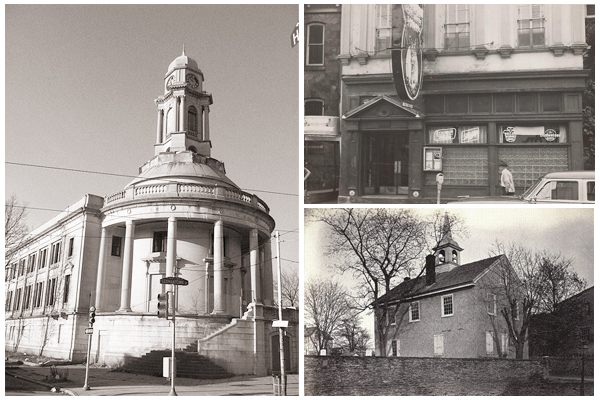
Once GUCDC becomes more entrenched in the neighborhood, one of its priorities will be re-utilizing the historic Germantown Town Hall. Churchville says that the re-use of Town Hall will be a personal commitment of his. He wants to take advantage of the Civil War-era building’s location across from Germantown High School by turning it into a building of learning that will feature post-secondary level science, technology, and math and high-school level “green entrepreneur” training. The building is up for sale by the Philadelphia Industrial Development Corporation (PIDC).
Another GUCDC priority will be to clean up the Chelten and Germantown Ave business corridors. The corridors form perpendicular Main Streets feature a diverse selection of small businesses, but are pockmarked by trash and other quality-of-life problems. The CDC has already held clean-ups along Chelten, and has proven its intimate concern with the avenue since its days speaking out against the new shopping center at Chelten and Pulaski.
It’s not hard to guess that GUCDC sees Germantown’s history playing a vital role in the area’s future. Barbara Hogue, the executive director at Historic Germantown, is hoping to assist in this effort. She says her organization has submitted a grant application to the Pew Charitable Trust for “the interpretation of the enduring search for freedom in Germantown.” If they receive the grant, Hogue foresees Historic Germantown working setting up pop-up exhibits at vacant storefronts and organizing lectures at local coffee shops in an event commemorating the anniversary of the Emancipation Proclamation.
On Tuesday, city officials, business owners, and other stakeholders sat down at the Flying Horse business center on Pulaski Avenue to discuss the future of the Germantown Special Services District, the agency created in 1995 to collect revenue from property owners in order to fund improvements, like street cleaning, along Germantown Avenue. For nearly two years, the agency has been dormant following a decision by City Council not to reauthorize its board, widely regarded as ineffective and closely tied to the corrupt and now defunct non-profit, Germantown Settlement. That group imploded in 2010 after evidence emerged suggesting rampant misspending by the group’s director, Emmanuel Freeman, raising endless questions about the fate of nearly $100 million sunk into the organization over 20 years.
Waves of scandal and city intervention have left the neighborhood largely leaderless at the local level, particularly in the realm of economic development. As the city tinkers with the GSSD, other grassroots organizations have struggled to emerge from the rubble left behind by the collapse of Germantown Settlement and defy the lingering skepticism of officials who believe that the ancient neighborhood is a black hole for government dollars.
Germantown Avenue | Photo: Theresa Stigale
The consequence of this has been that holdovers, like the GSSD, are still paralyzed, and non-profits that have stepped up to fill the void left by Germantown Settlement have had a tough time getting support from the city. Government investment, significant enough during the bad old days, has slowed to a trickle, and one of Philadelphia’s most important, and most under-realized, neighborhoods remains in limbo. The Germantown United Community Development Corporation wants to be the group that breaks the cycle.
The group emerged out of a battle last year over the redevelopment of a neighborhood Shop-Rite into an auto-oriented strip mall with an anchor Sav-a-Lot, a discount chain that residents criticized as lowering expectations for commercial activity in Germantown. Finding few extant community groups to rally behind, neighbors collaborated to form their own.
Andrew Trackman of Germantown United on Maplewood Mall | Photo: Theresa Stigale
“A lot of protest against this was because basically neighbors felt that this was going to be another dollar store-type, low-end development,” said Andrew Trackman, a marketing consultant who joined Germantown United’s board earlier this year. “There was this perception that Germantown was a certain way, while there was plenty of evidence that it wasn’t.”
Yvonne Haskins, a lawyer and co-chair of Germantown United’s Program Committee, says the Sav-a-Lot project was the last gasp of the dysfunctional, politically connected leadership that profited from selling the neighborhood as a dumping ground.
“This was primarily because Germantown has had such fractured and corrupt leadership. You have this perception of Germantown as being a low-income, blighted community, when most of the housing stock is pretty strong,” said Haskins. “It’s unfortunate that because our community is majority black that it’s also associated with blight. That stereotype has prevailed, and that’s why we got a dollar store in a transit-oriented development. Both middle and low income shoppers want better options.”
The Sav-a-Lot opened last December, but rather than dissolving, Germantown United used the attention and membership it had gained to try to shape commercial development in the neighborhood. The group began hosting public planning sessions, adopted the “CDC” moniker, and filed for non-profit status. It has spent the last several months strengthening its board, which, alongside business owners and employees of the neighborhood’s numerous historic sites, now includes a professor, an investment banker, a member of the city’s Commerce Department, and a project manager of Post Brothers Apartments.
Chelten Avenue | Photo: Theresa Stigale
Haskins is quick to trumpet the diverse and powerful group Germantown United has assembled, as well as the artistic events and neighborhood movie nights sponsored by the volunteer board. However, she notes that traditional investment and business development, the primary activities of most CDCs in Philadelphia, have been non-existent. The reason is simple: the group has virtually no funding, and therefore no staff.
“These are small activities compared to the kind of strategic planning we’d like to do, but the only money we have right now is money we’ve personally contributed out of our own pockets. Our job is to try to raise money to get an executive director,” said Haskins.
In most neighborhoods, CDCs draw stability from small but reliable funding streams and tax credit programs managed from the city’s Commerce Department to at least maintain essential employees. Haskins says her group wasn’t ready to apply for a corridor manager grant offered by the Commerce Department last January, but will do so this year. However, she says the city could still offer other forms of financial support in the meantime. She expressed uncertainty over where the organization stands with the city and what the reactivation of the GSSD will mean for its future.
“It’s slow. I couldn’t tell you where the city is in all this, but Commerce has been encouraging. We’re working on trying to convince them that we’re ready, but they say they want to see us build more capacity. It’s a chicken and egg situation. How do you build capacity with no money?” said Haskins, who says Germantown United is currently trying to seek out donations to hire a part-time fundraiser.
There is a certain level of irony to a situation where a new, relatively transparent group is struggling to even get a startup grant, while Germantown Settlement, for decades, was awash with millions of dollars and virtually no oversight. Haskins says part of it is politics.
“Well, [former City Councilwoman] Donna Reed Miller was probably the biggest ally of Germantown Settlement, and [1st Congressional District Representative] Chaka Fattah,” said Haskins, noting that Germantown United does not have similar political backing.
Miller’s recently elected replacement, Fattah protégé Cindy Bass, has invested time and attention into the reactivation of the GSSD, but has not taken a stance on Germantown United.
“I don’t know who she would favor to have that kind of status in Germantown,” said Haskins, who wondered if Germantown United’s dustup over the grocery store damaged their reputation with pols.
In an official statement to the Hidden City Daily, Bass said, “Community groups like the Germantown Artists Roundtable, Germantown United, Germantown Restoration CDC, and Germantown Community Connection have been great partners so far and we look forward to continuing work with these groups and others.”
Her statement mirrors those by other city officials, who say they are hesitant to “play favorites” in the neighborhood non-profit circle. While neither Haskins nor representatives from the Commerce Department characterized the groups as being combative or even having redundant objectives (Germantown Restorations focuses on affordable housing and the Germantown Community Connection is a community group that is not explicitly focused on economic development), deputy commerce director Kevin Dow said that preemptively “anointing” one organization was inappropriate and had the potential to stir up animosity and unnecessary competition.
There is also a concern that supporting a group with no track record could lead to another Germantown Settlement scenario down the road. Dow acknowledged that he wanted to see more development and continued transparency from organizations like Germantown United, which he said had made promising strides, before the city vested its limited resources.
“Germantown United is, quite simply, a startup organization. We also don’t want to be in the position where we are the sole funder of an organization, because then they become reliant on government funding for everything,” he said.
Dow acknowledged that this process takes time, but said the city was not abandoning Germantown in the meantime. “We’re not waiting. We’re trying to identify resources to improve the corridor,” he said, pointing to the city’s façade improvement program and streetscape improvements to Germantown Avenue as evidence that the city was still investing in the neighborhood. Moreover, Bass’s office claimed in its statement to the Daily that it had “started planning with the Commerce Department for a revitalization of Maplewood Mall; met with Parks and Recreation to plan a makeover of Wister House and Vernon Park; spoken with the Redevelopment Authority regarding the Germantown Avenue YMCA building.”
It’s possible that the city is simply putting the crop of post-Germantown Settlement organizations through their paces to see which groups have the drive and stability to warrant a long-term financial commitment. In certain ways, it is refreshing to see City Hall not tossing money at potential fly-by-night organizations, but nothing can take away from the fact that in the meantime, the vast neighborhood still struggles, leaderless. It is a familiar state for Germantown, a neighborhood of unparalleled potential, with endless historical assets and a sprawling, heartbreakingly beautiful commercial avenue, all of which have teetered on the brink of collapse for decades.
But Tuesday’s meeting on the future of the special services district may signal that for the first time since the collapse of Germantown Settlement, there is real hope the leadership impasse may break. In January, the City will put out an RFP for a commercial corridor management grant, creating the possibility that a strengthened Germantown United will receive funding for the first time. Councilwoman Bass’ office said they anticipated the new Special Service District board to be approved on April 19th, setting the stage for street cleaning and other operations to resume by June, 2013.
Since the Germantown United CDC incorporated late last year, its founding members have met in small groups and at large forums, discussing and eventually agreeing on a set of bylaws and appointing a board of directors to run things.
The new CDC has drawn a varied crop of members, from John Churchville, a respected businessman “of a certain age,” to Emaleigh Doley, a young professional who’s been trying to improve Germantown starting on her own block.
But there is room, and need, for more.
How to get involved
Applications and information about serving on the board are available on the group’s website, along with a questionnaire and the Code of Conduct for board members.
Germantown United is currently accepting applications to join its first full board of directors. Nine members of the original steering committee will serve on the permanent board, but a full board will include up to 21 members, drawn from various constituencies.
A nominating committee, chaired by Sandi Weckesser, is gathering the applications and will make selections. Some steering-committee members, like Doley, are not seeking board seats but will continue to be involved in committees.
“People are putting in an incredible amount of hours” on meetings, research and organization, Doley, 28, said.
Evolving neighborhood focuses
Though many got involved around the Chelten Plaza fight — the catalyzing event for Germantown United — revitalization of the neighborhood’s commercial corridors overall is the focus going forward.
“I feel like it has shifted in a very positive direction,” Doley said. “The best thing to come out of Chelten Plaza is the organization, the uniting.”
Zoning is also an issue, one highlighted by the recent minor flap that erupted when New Directions For Women sought a variance to continue operating a correctional facility on Germantown Avenue.
Many in the community had never realized the facility existed, and without one umbrella civic group or zoning committee for Germantown, it was left to the property’s owner to hold a public meeting to let people know what was going on.
A common zoning-review committee for the neighborhood would give developers a starting point for communication and accountability with the community.
Weckesser has lived in Germantown since the 1970s — her house, a Victorian castle, is sort of a local celebrity — but for her, too, it took the Chelten Plaza debacle to get her really involved in neighborhood activism.
A former development executive for Fox Chase Cancer Center, she’s worked with corporate boards of directors and is coordinating the selection of board members for Germantown United.
The rules
Anyone is welcome to apply, but there will be standards, Weckesser said.
The group’s bylaws call for the board to be comprised of about 30 percent “highly functioning members of the Germantown community,” likely representatives of other civic groups; 15 percent local business owners; 15 percent commercial developers with track records of sustainable smart-growth projects; and 40 percent professionals or experts in areas such as accounting, law and design.
Bylaws also set forth requirements for involvement for board members and require outside audits of Germantown United’s budgets — not that the group has any money right now, but members of the steering committee thought it was important to set ethical standards from day one, Weckesser said.
Germantown United’s website calls for an April 1 deadline on applications, but that’s not an absolute cutoff date, Weckesser said.
NewsWorks has partnered with independent news gatherer PlanPhilly to provide regular, in-depth, timely coverage of planning, zoning and development news.
New Germantown CDC tries to “dream big” about neighborhood’s future
NOVEMBER 18, 2011
Nearly two dozen Germantowners met at the renovated Greene Street YMCA to “dream big” about the future of the commercial corridors in the neighborhood.
This came after a steering committee and representatives from five West Germantown community organizations mobilized behind a newly formed community development corporation called Germantown United. Last week, they said they wanted to go public with their ideas.
Among their visions were enlisting a Fairmount Park Ranger to patrol Vernon Park, promoting housing restoration, hosting workshops, bolstering town watches and teaming up with existing programs and organizations like a local entrepreneurship apprentice program run by the Greater Germantown Business Association.
The group also discussed an idea to replace unsightly metal security grates along Germantown and Chelten avenues with historic photographs. That way, the group envisioned, the evening scene would go from ghost town to providing a retro peek at the business strip of a century ago.
When residents listed the types of retail businesses that would bolster their ideal corridor, they cited flourishing office and art-supply stores, locally owned hardware stores and sit-down restaurants. They also created a directory of stores they already frequent and want to promote.
Seeking cooperation
One of Germantown United’s lead organizers is Yvonne Haskins, the attorney for the Chelten Plaza zoning appeal. She admitted the process thus far has been led by those willing to volunteer time as opposed to broader outreach.
“We are incorporated but not structured yet,” she said. “What we’re trying to do right now is learn as much as we can and engage the community as much as we can in a short period of time.”
Haskins noted that the focus is on the neighborhood’s western portion because East Germantown residents have existing organizations in place. Members of this group say the Chelten Plaza debate spurred them into action.
Those involved in Germantown United say they aren’t trying to replace Germantown Community Connection, a local civic group; they hope to partner with them on neighborhood projects. One community development organization, Germantown Settlement, left a void after their assets were ordered to be liquidated in bankruptcy.
In the wake of Settlement’s fall, GCC considered becoming a CDC (an organization which uses grant- and other funding for projects) but has not pursued it. Some GCC members involved with Germantown United say they were interested in the GCC idea last year but saw little forward movement.
“There’s something going on with us. As long as we work together, struggle together and even fight [with each other] together, it’s for something bigger than us,” said John Churchville, president of the Greater Germantown Business Association and leader of the Libertarian Fellowship Community Development Corp.
Beth Zug, who moved to Germantown four years ago and is active with the Penn Knox Neighbors Association, said her “break-out” group discussed issues like gentrification and the need for more diversity in businesses. They talked about the need for repairing relationships in the neighborhood as well.
“Unless they build the trust of the community, they are just going to be running into a wall,” she said. “That way it doesn’t seem like there are the same twenty people trying to decide what is best for the community.”
The Germantown United CDC steering committee plans to hold a community meeting soon.
It can happen. Over and over, former Pennsylvania Gov. Ed Rendell stressed that simple, but important, phrase as he spoke Thursday night to a room filled with Germantown residents who desperately want to turn the neighborhood’s fortunes around. “Anything…