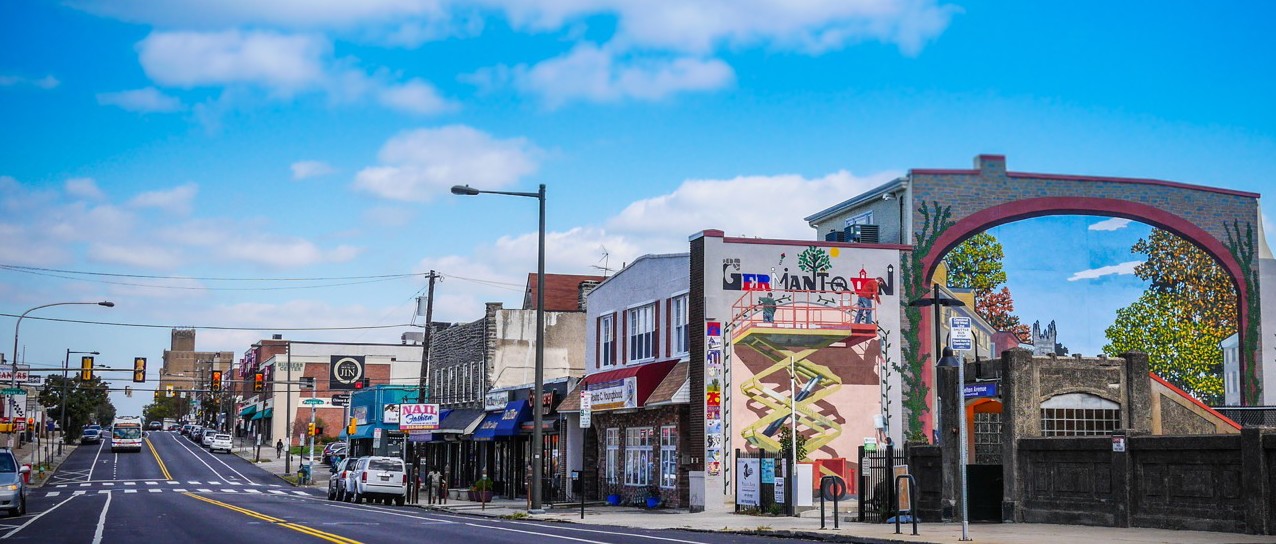
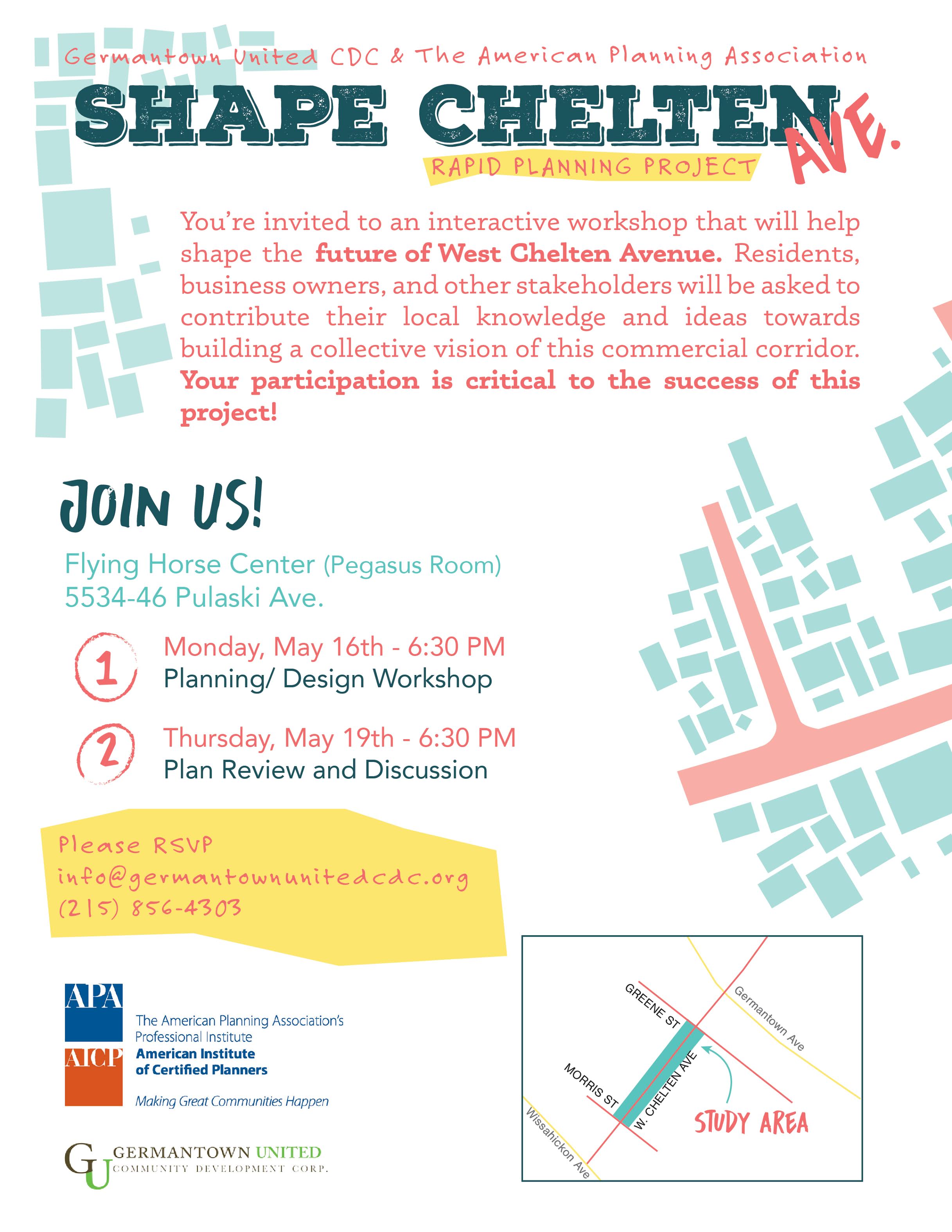
Germantown United CDC applied for and received theAmerican Planning Association’s Community Planning Assistance Team (CPAT) to conduct a brief and focused planning effort on a small area of Germantown. Since GUCDC’s focus is on commercial corridors, the portion of West Chelten Avenue between Morris Street and Greene Street was selected as the study area.
The CPAT consists of volunteer urban planners and professionals from all over the country who come into an area to work for one week’s time, as part of a rapid planning process. Our project will take place during the week of May 16-20, 2016 and include two public events on May 16 and May 19. You’re invited to participate! Residents, business owners, and other stakeholders will be asked to contribute their local knowledge and ideas towards building a collective vision of this commercial corridor.
Events
1. Monday, May 16th at 6:30PM
Interactive planning/design workshop to gather community input | Share on Facebook
2. Thursday, May 19th at 6:30PM
Presentation of the results and discussion | Share on Facebook
Both public meetings will be held at the Pegasus Room at The Flying Horse Center, located at 5534 Pulaski Ave (Chelten and Pulaski). During the week, the Community Planning Assistance Team will be using the Imperfect Gallery at 5601 Greene St as their central workspace and headquarters (stop in and say hello). To RSVP to either event, email [email protected] or call 215-856-4303.
Project Background
Since 2014, Germantown United CDC (GUCDC) has been working with several other groups in Germantown to seek planning resources for Germantown. (Organizational partners include: Historic Germantown, Germantown Community Connection, G’town Restoration CDC, the City Planning Commission.) In that spirit, GUCDC applied for and received theAmerican Planning Association’s Community Planning Assistance Team (CPAT) to conduct a brief and focused planning effort on a small portion of Germantown.
West Chelten Avenue between Morris Street and Greene Street was selected as the study area. This stretch includes one of Germantown’s busiest SEPTA train stations and bus stops, one of the most dangerous intersections in Philadelphia for pedestrians/vehicular accidents (Wayne Ave/Chelten Ave), along with a large swath of vacant properties with lots of potential (former CareerLink building; former House of Jin property; continued vacancies at Chelten Plaza; etc.) along with many other key spaces (Mastery Picket Charter School, the Burgess Center, the former-Pathmark building, and more).
We hope that the results of this project, which will be shared and available to the public, will give all of us who are dedicated to bringing jobs and economic improvement to Germantown some new tools to achieve that end. There is value in keeping the momentum going, and the focus on a critical part of Chelten Avenue.
About the American Planning Association
The American Planning Association provides leadership in the development of vital communities by advocating excellence in planning, promoting education and citizen empowerment, and providing our members with the tools and support necessary to meet the challenges of growth and change.
Through the Community Planning Assistance Team program, the APA organizes volunteer planning teams tailored specifically to a community’s needs. Members offer their time and expertise to people and places where additional resources are needed. This program is supported through donations.
Why CPAT?
By pairing a multidisciplinary team of expert planning professionals from around the country with community members, key stakeholders, and relevant decision makers, the place-based initiative seeks to foster community education, engagement, and empowerment.
Each team is selected for the specific expertise needed on the project to offer pro bono assistance in developing a framework or vision plan that promotes a sustainable, livable, economically vibrant, and healthy community.
Communities facing a range of challenges including, but not limited to, social equity and affordability, economic development, sustainability, consensus building, and urban design are well-suited for assistance through the program.
Projects focus on localities with a demonstrated need for assistance, where planning resources and expertise may not otherwise be available.
CPAT projects are collaborative efforts with shared responsibilities. CPATs and communities work together throughout the process.
APA contributes the time of its staff and volunteer experts while the recipient communities cover travel costs.
Germantown United CDC is 1 of 158 finalists in The John S. and James L. Knight Foundation’s Knight Cities Challenge!
Civic innovators from across the country submitted more than 4,500 ideas to this year’s challenge. Submissions came from many nonprofit and government organizations, as well as design experts, urban planning organizations and individuals focused on making their cities more successful.
Here’s our one sentence pitch:
Beyond the Census: Building a Positive Data Story of a Community’s Human Resources Increasing economic opportunity by discovering new data about underserved neighborhoods that attract new businesses and investment.
Germantown neighborhood is well-represented, with three projects proposed by Germantown residents making the final round – congratulations also to Amanda Staples and Vashti DuBois! Winners will be announced in Spring 2016. Stay tuned.
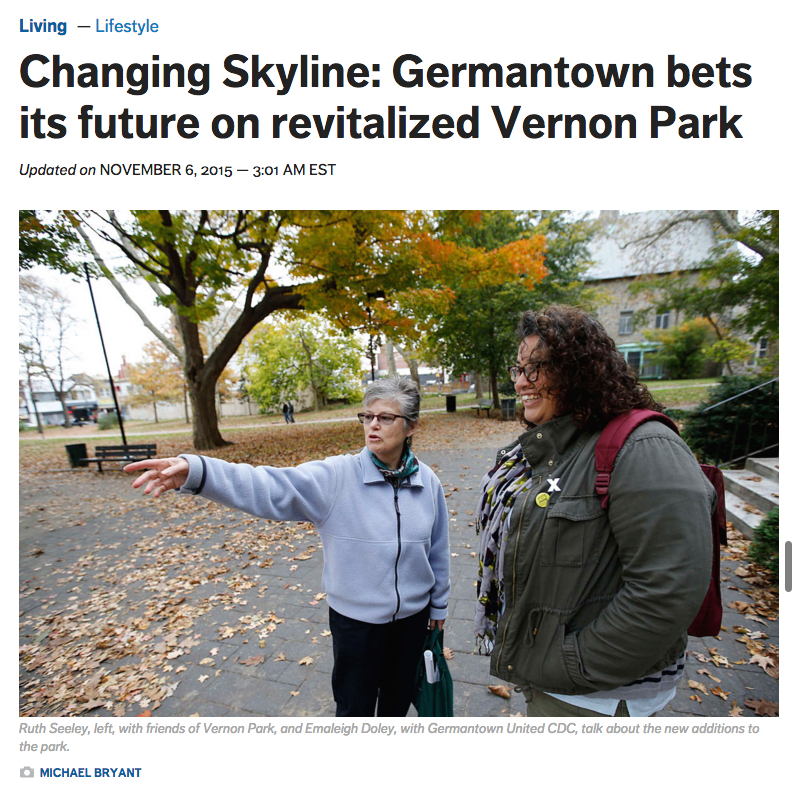
The article features Ruth Seeley, the president of the Friends of Vernon Park – the organization that courageously led the charge for the park renovations – alongside Germantown United CDC’s new Commercial Corridor Manager Emaleigh Doley, who discussed the challenges impacting efforts to improve the nearby shopping district.
This is an exciting time for Germantown. If you are energized about the neighborhood’s potential, consider joining one of the many civic groups – like Friends of Vernon Park, your local Registered Community Organization (RCO), or GU’s own volunteer committee – and get involved in moving Germantown forward!
Germantown United CDC gets tough love from community rejuvenators
MARCH 1, 2012 | By AMY Z. QUINN
Photos Courtesy of WHYY
The community development experts who came to Northwest Philadelphia on Wednesday to meet with Germantown United Community Development Corp. and offer advice didn’t pull any punches in talking about the challenges ahead.
Everyone in the community won’t agree with what you’re doing — and they don’t have to, one advised.
Be willing to go to great lengths to get people involved — even if it means sometimes playing on their fears, another said.
Understand that gentrification will mean that some people will leave — and that’s not always a bad thing, yet another said.
And most of all, they offered, be ready to fight against low expectations — from within and without.
“People have low expectations, and it gives them an excuse not to engage,” said Colvin W. Grannum, president of the Bedford-Stuyvesant Restoration Corp., which began revitalization efforts in New York City in 1967.
Similar challenges
At the panel discussion, held on the Germantown Friends School campus, Grannum talked about some of the challenges the nation’s first community development corporation has faced in the 45 years since it was started by U.S. Senators Robert F. Kennedy and Jacob Javits.
While Bed-Stuy had riots that touched off its downward spiral, Germantown doesn’t have one signature traumatic event that spurred its decline. Decades of middle-class flight were worsened by Germantown Settlement’s corruption and neglect. However, many of the challenges are the same, Grannum said.
His group had success early on with residential development, but that alone won’t rebuild a community, panelists said.
“The easiest thing to do is build houses,” said Grannum, but the greater challenge is creating a mix of residential, commercial and community uses. Some startups will fail while others will thrive, but many different approaches should be tried.
In Bed-Stuy, the CDC has backed everything from a Pathmark supermarket to artist space and schools, aimed at keeping residents working and shopping in the neighborhood.
“People just got in the habit of going outside the community to shop,” he said. Then, they assumed that “if they put something here, it’s not going to be good anyway.”
That struck a chord with the audience in Germantown, where the desire for more upscale retail bumps against the reality of the lower-income shoppers who frequent the commercial corridors on Germantown and Chelten avenues.
A new direction ahead?
Still, there was acknowledgment that Germantown seems poised to make a change.
“Germantown has some real assets to build on, and there’s real potential to create an organization that has some lasting power,” said Rick Sauer, executive director of the Philadelphia Association of Community Development Corporations.
One thing Germantown has working for it is its history. Founded in 1683, the neighborhood is home to 15 historic sites, seven of which are National Historic Landmarks. Each year, more than 40,000 visitors and school children come to see the neighborhood’s offerings, said Barbara Hogue of Historic Germantown.
But despite being a Colonial Historic District, it’s difficult to draw outside tourists and even tougher to keep them in Germantown once they arrive. Hogue has applied for a grant through the Pew Charitable Trust’s Heritage Philadelphia Program, in hopes of creating a festival in 2013 around a theme of the struggle for freedom.
Stephen P. Mullin, a former finance and commerce director and now principal at Econsult, talked about the importance of controlling the real estate involved, whether through CDC ownership or in working with property owners who are also vested in the community.
Engage those who want to gripe
Some of the most practical advice came from Sandy Salzman of the New Kensington CDC, which has put in 27 tough years trying to craft new development and a renewed sense of identity in Fishtown, Kensington and Port Richmond.
“There are always people who are going to get involved when they have something to gripe against,” she said. Her message: Even if residents come to the table to fight against something — in her neighborhood, it was the SugarHouse Casino — seize the chance to keep them involved.
Salzman said when her group started to notice artists and other creative professionals moving northward from Old City and Northern Liberties, there was a concerted effort to court them.
“We decided that we could either capture them and try to get them to stay, or we could just watch them keep on moving along,” she said
So, they created the Frankford Avenue Arts District and events like the Kensington Kinetic Sculpture Derby. Now, they are now watching the neighborhood fashion itself a new identity.
An audience-submitted question asked what Germantown should do to attract better retailers in the face of proliferating nail salons and beauty shops. Salzman suggested creating a beauty and fashion district to encourage quality.
John Churchville, Germantown United CDC’s first president, called it the group’s “coming out party.”
Character, culture and competence will be the group’s touchstones, he said, pledging an environment of transparency and action.
“We’re not here to fight and to fuss and carry on,” he said. “We are here to get something done.”
—
NewsWorks has partnered with independent news gatherer PlanPhilly to provide regular, in-depth, timely coverage of planning, zoning and development news.
On Tuesday, city officials, business owners, and other stakeholders sat down at the Flying Horse business center on Pulaski Avenue to discuss the future of the Germantown Special Services District, the agency created in 1995 to collect revenue from property owners in order to fund improvements, like street cleaning, along Germantown Avenue. For nearly two years, the agency has been dormant following a decision by City Council not to reauthorize its board, widely regarded as ineffective and closely tied to the corrupt and now defunct non-profit, Germantown Settlement. That group imploded in 2010 after evidence emerged suggesting rampant misspending by the group’s director, Emmanuel Freeman, raising endless questions about the fate of nearly $100 million sunk into the organization over 20 years.
Waves of scandal and city intervention have left the neighborhood largely leaderless at the local level, particularly in the realm of economic development. As the city tinkers with the GSSD, other grassroots organizations have struggled to emerge from the rubble left behind by the collapse of Germantown Settlement and defy the lingering skepticism of officials who believe that the ancient neighborhood is a black hole for government dollars.
Germantown Avenue | Photo: Theresa Stigale
The consequence of this has been that holdovers, like the GSSD, are still paralyzed, and non-profits that have stepped up to fill the void left by Germantown Settlement have had a tough time getting support from the city. Government investment, significant enough during the bad old days, has slowed to a trickle, and one of Philadelphia’s most important, and most under-realized, neighborhoods remains in limbo. The Germantown United Community Development Corporation wants to be the group that breaks the cycle.
The group emerged out of a battle last year over the redevelopment of a neighborhood Shop-Rite into an auto-oriented strip mall with an anchor Sav-a-Lot, a discount chain that residents criticized as lowering expectations for commercial activity in Germantown. Finding few extant community groups to rally behind, neighbors collaborated to form their own.
Andrew Trackman of Germantown United on Maplewood Mall | Photo: Theresa Stigale
“A lot of protest against this was because basically neighbors felt that this was going to be another dollar store-type, low-end development,” said Andrew Trackman, a marketing consultant who joined Germantown United’s board earlier this year. “There was this perception that Germantown was a certain way, while there was plenty of evidence that it wasn’t.”
Yvonne Haskins, a lawyer and co-chair of Germantown United’s Program Committee, says the Sav-a-Lot project was the last gasp of the dysfunctional, politically connected leadership that profited from selling the neighborhood as a dumping ground.
“This was primarily because Germantown has had such fractured and corrupt leadership. You have this perception of Germantown as being a low-income, blighted community, when most of the housing stock is pretty strong,” said Haskins. “It’s unfortunate that because our community is majority black that it’s also associated with blight. That stereotype has prevailed, and that’s why we got a dollar store in a transit-oriented development. Both middle and low income shoppers want better options.”
The Sav-a-Lot opened last December, but rather than dissolving, Germantown United used the attention and membership it had gained to try to shape commercial development in the neighborhood. The group began hosting public planning sessions, adopted the “CDC” moniker, and filed for non-profit status. It has spent the last several months strengthening its board, which, alongside business owners and employees of the neighborhood’s numerous historic sites, now includes a professor, an investment banker, a member of the city’s Commerce Department, and a project manager of Post Brothers Apartments.
Chelten Avenue | Photo: Theresa Stigale
Haskins is quick to trumpet the diverse and powerful group Germantown United has assembled, as well as the artistic events and neighborhood movie nights sponsored by the volunteer board. However, she notes that traditional investment and business development, the primary activities of most CDCs in Philadelphia, have been non-existent. The reason is simple: the group has virtually no funding, and therefore no staff.
“These are small activities compared to the kind of strategic planning we’d like to do, but the only money we have right now is money we’ve personally contributed out of our own pockets. Our job is to try to raise money to get an executive director,” said Haskins.
In most neighborhoods, CDCs draw stability from small but reliable funding streams and tax credit programs managed from the city’s Commerce Department to at least maintain essential employees. Haskins says her group wasn’t ready to apply for a corridor manager grant offered by the Commerce Department last January, but will do so this year. However, she says the city could still offer other forms of financial support in the meantime. She expressed uncertainty over where the organization stands with the city and what the reactivation of the GSSD will mean for its future.
“It’s slow. I couldn’t tell you where the city is in all this, but Commerce has been encouraging. We’re working on trying to convince them that we’re ready, but they say they want to see us build more capacity. It’s a chicken and egg situation. How do you build capacity with no money?” said Haskins, who says Germantown United is currently trying to seek out donations to hire a part-time fundraiser.
There is a certain level of irony to a situation where a new, relatively transparent group is struggling to even get a startup grant, while Germantown Settlement, for decades, was awash with millions of dollars and virtually no oversight. Haskins says part of it is politics.
“Well, [former City Councilwoman] Donna Reed Miller was probably the biggest ally of Germantown Settlement, and [1st Congressional District Representative] Chaka Fattah,” said Haskins, noting that Germantown United does not have similar political backing.
Miller’s recently elected replacement, Fattah protégé Cindy Bass, has invested time and attention into the reactivation of the GSSD, but has not taken a stance on Germantown United.
“I don’t know who she would favor to have that kind of status in Germantown,” said Haskins, who wondered if Germantown United’s dustup over the grocery store damaged their reputation with pols.
In an official statement to the Hidden City Daily, Bass said, “Community groups like the Germantown Artists Roundtable, Germantown United, Germantown Restoration CDC, and Germantown Community Connection have been great partners so far and we look forward to continuing work with these groups and others.”
Her statement mirrors those by other city officials, who say they are hesitant to “play favorites” in the neighborhood non-profit circle. While neither Haskins nor representatives from the Commerce Department characterized the groups as being combative or even having redundant objectives (Germantown Restorations focuses on affordable housing and the Germantown Community Connection is a community group that is not explicitly focused on economic development), deputy commerce director Kevin Dow said that preemptively “anointing” one organization was inappropriate and had the potential to stir up animosity and unnecessary competition.
There is also a concern that supporting a group with no track record could lead to another Germantown Settlement scenario down the road. Dow acknowledged that he wanted to see more development and continued transparency from organizations like Germantown United, which he said had made promising strides, before the city vested its limited resources.
“Germantown United is, quite simply, a startup organization. We also don’t want to be in the position where we are the sole funder of an organization, because then they become reliant on government funding for everything,” he said.
Dow acknowledged that this process takes time, but said the city was not abandoning Germantown in the meantime. “We’re not waiting. We’re trying to identify resources to improve the corridor,” he said, pointing to the city’s façade improvement program and streetscape improvements to Germantown Avenue as evidence that the city was still investing in the neighborhood. Moreover, Bass’s office claimed in its statement to the Daily that it had “started planning with the Commerce Department for a revitalization of Maplewood Mall; met with Parks and Recreation to plan a makeover of Wister House and Vernon Park; spoken with the Redevelopment Authority regarding the Germantown Avenue YMCA building.”
It’s possible that the city is simply putting the crop of post-Germantown Settlement organizations through their paces to see which groups have the drive and stability to warrant a long-term financial commitment. In certain ways, it is refreshing to see City Hall not tossing money at potential fly-by-night organizations, but nothing can take away from the fact that in the meantime, the vast neighborhood still struggles, leaderless. It is a familiar state for Germantown, a neighborhood of unparalleled potential, with endless historical assets and a sprawling, heartbreakingly beautiful commercial avenue, all of which have teetered on the brink of collapse for decades.
But Tuesday’s meeting on the future of the special services district may signal that for the first time since the collapse of Germantown Settlement, there is real hope the leadership impasse may break. In January, the City will put out an RFP for a commercial corridor management grant, creating the possibility that a strengthened Germantown United will receive funding for the first time. Councilwoman Bass’ office said they anticipated the new Special Service District board to be approved on April 19th, setting the stage for street cleaning and other operations to resume by June, 2013.
New Germantown CDC tries to “dream big” about neighborhood’s future
NOVEMBER 18, 2011
Nearly two dozen Germantowners met at the renovated Greene Street YMCA to “dream big” about the future of the commercial corridors in the neighborhood.
This came after a steering committee and representatives from five West Germantown community organizations mobilized behind a newly formed community development corporation called Germantown United. Last week, they said they wanted to go public with their ideas.
Among their visions were enlisting a Fairmount Park Ranger to patrol Vernon Park, promoting housing restoration, hosting workshops, bolstering town watches and teaming up with existing programs and organizations like a local entrepreneurship apprentice program run by the Greater Germantown Business Association.
The group also discussed an idea to replace unsightly metal security grates along Germantown and Chelten avenues with historic photographs. That way, the group envisioned, the evening scene would go from ghost town to providing a retro peek at the business strip of a century ago.
When residents listed the types of retail businesses that would bolster their ideal corridor, they cited flourishing office and art-supply stores, locally owned hardware stores and sit-down restaurants. They also created a directory of stores they already frequent and want to promote.
Seeking cooperation
One of Germantown United’s lead organizers is Yvonne Haskins, the attorney for the Chelten Plaza zoning appeal. She admitted the process thus far has been led by those willing to volunteer time as opposed to broader outreach.
“We are incorporated but not structured yet,” she said. “What we’re trying to do right now is learn as much as we can and engage the community as much as we can in a short period of time.”
Haskins noted that the focus is on the neighborhood’s western portion because East Germantown residents have existing organizations in place. Members of this group say the Chelten Plaza debate spurred them into action.
Those involved in Germantown United say they aren’t trying to replace Germantown Community Connection, a local civic group; they hope to partner with them on neighborhood projects. One community development organization, Germantown Settlement, left a void after their assets were ordered to be liquidated in bankruptcy.
In the wake of Settlement’s fall, GCC considered becoming a CDC (an organization which uses grant- and other funding for projects) but has not pursued it. Some GCC members involved with Germantown United say they were interested in the GCC idea last year but saw little forward movement.
“There’s something going on with us. As long as we work together, struggle together and even fight [with each other] together, it’s for something bigger than us,” said John Churchville, president of the Greater Germantown Business Association and leader of the Libertarian Fellowship Community Development Corp.
Beth Zug, who moved to Germantown four years ago and is active with the Penn Knox Neighbors Association, said her “break-out” group discussed issues like gentrification and the need for more diversity in businesses. They talked about the need for repairing relationships in the neighborhood as well.
“Unless they build the trust of the community, they are just going to be running into a wall,” she said. “That way it doesn’t seem like there are the same twenty people trying to decide what is best for the community.”
The Germantown United CDC steering committee plans to hold a community meeting soon.
As a result of our annual Board Retreat in October of this past year, Germantown United CDC (GUCDC) decided to adopt the National Main Street model as a way to guide our work as the commercial corridor manager. The Main Street Approach, a 4 point strategy to revitalize commercial corridors through community input and collaboration, was developed by the National Main Street Center, a subsidiary of the National Trust for Historic Preservation. The meeting, held on Saturday, February 7, was facilitated by Donna Ann Harris, a nationally recognized Community district revitalization and Historic Preservation consultant. Ms. Harris guided the meeting of 25 community leaders and GUCDC Board members and volunteers through the Main Street Approach, and how it can be utilized in Germantown. GUCDC has established four committees to guide our work going forward. Those committees are: Promotions, Design, Organization, Economic Restructuring.
The Main Street ApproachTM is fundamentally a self-help program, that uses every kind of local asset—be they historic buildings, community organizations, and talented local residents who all join together to create events and projects make their downtown better. Local Main Street programs foster the creativity of community residents through committee work. Committees devise local projects to bring people back to shop and dine; ensure the district is clean, safe and attractive for shoppers; help existing business expand and recruit new, complementary business and finally create a management organization to raise funds, recruit partners, and communicate to the public about its work. Local Main Street programs are driven by volunteers, who learn about the market realities and make incremental change in the district over time. GUCDC welcomes volunteers from the community to join these committees. Organizations that are already doing projects in the committee areas are also welcome to join,and/or include and inform GUCDC of their projects.
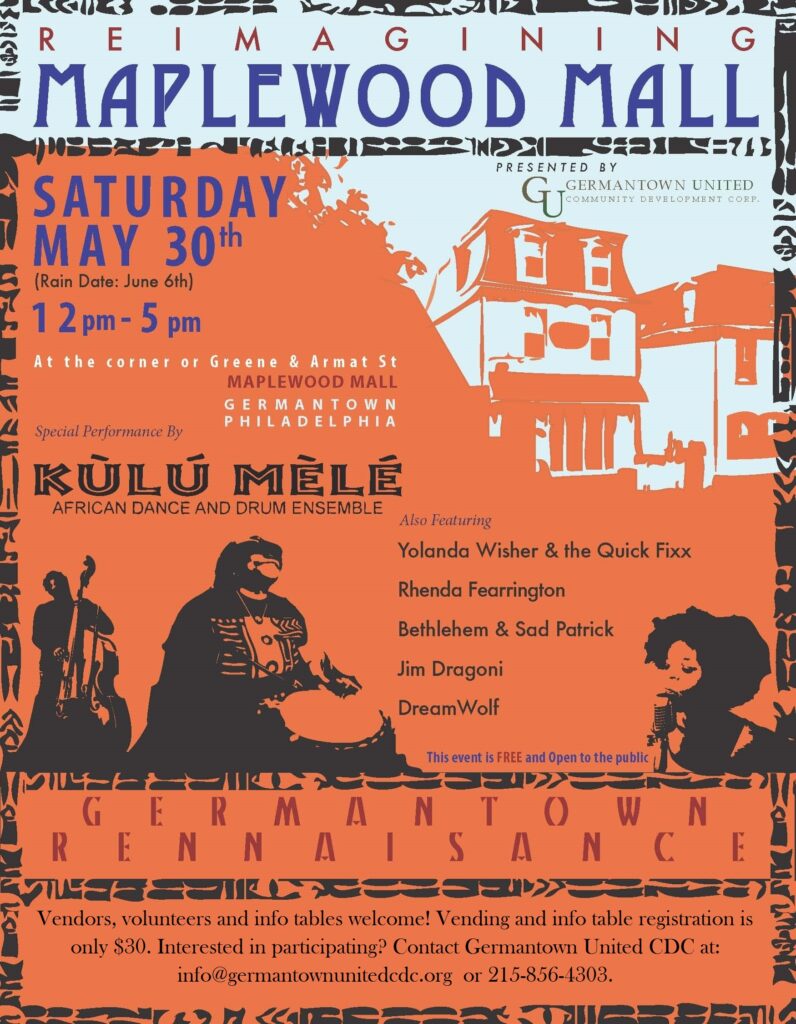
Germantown, Philadelphia, PA (May 13, 2015) The 3rd annual spring Re-imagine Maplewood Mall Festival will take place on Maplewood Mall (between Germantown Avenue and Greene Streets) on Saturday, May 30th (rain date June 6th), from 12pm to 5:00pm. This free event will offer live music, fo
od from restaurants in and around the Mall (Flower Café, K&J Caribbean, and Little Jimmies), locally made arts and crafts vendors, and entertainment for children. This year’s festival features a solid musical lineup, with a special performance by Kùlú Mèlé African Dance and Drum Ensemble, one of the City’s oldest and most well-regarded dance companies.
Building on the immense successes of the last three Re-imagining Maplewood Mall Festivals, Germantown United CDC is working with community stakeholders and local businesses to host this year’s Festival. Last year’s event drew hundreds of local residents, showcasing local talent and providing free family-friendly activities. The year’s event theme, “Germantown Renaissance”, is an opportunity to re-imagine Germantown, and Maplewood Mall, as an epicenter for creativity, music, food, literature, poetry and art.
“We want to not only showcase the brilliance of our own community”, said Germantown United CDC Executive Director Andy Trackman, “but demonstrate to Philadelphia that Germantown is a gathering place for the cutting edge in art and culture.”
In addition to Kulu Mele, the musical lineup also includes:
Jim Dragoni, a composer, guitarist and teacher with performance areas in blues, jazz and his own fiery original brand of hybridized cross genre art-music.
Bethlehem and Sad Patrick a vocal and guitar duo who specialize in songs of love, love lost, and love that would be better off lost. The duo recently released their first full-length CD, Did You Ever Do?
Live from NYC DreamWolf viaawQward talent – Jendog Lonewolf & Yalini Dream joined forces in 2011 to commemorate lives lost to police brutality. Rooted in ending the full continuum of violence and exploitation from the intimate to the global, from the street to the state, DreamWolf invokes a masterful collision of Hip Hop, poetry, theater & dance in their collaborative work, Above Street Level.
Rhenda Fearrington a Philadelphia jazz legend. She delivers an authentic and warm presentation of Jazz standards mixed with Soulful originals. This well established jazz vocalist has a history of working with artists such as Roberta Flack and MTUME and kicked off the 2014 Center City Jazz Festival.
Yolanda Wisher & The Quick Fixx the group features Germantown born and Philadelphia- based poet, singer, musician, and educator Yolanda Wisher
The Re-imagining Maplewood Mall Festivals started in 2013 as an open-air café/block party, and to engage with residents to re‐imagine what the Maplewood Mall could be: a space for families and neighbors to enjoy a nice afternoon out in Germantown. Since then, the event has grown to become an annual much-anticipated community festival.
“These festivals are an opportunity to bring the entire Germantown community together and support our locally based economy while helping to create the vibrancy that once used to exist in Germantown’s commercial district”, said Germantown United CDC Board President Garlen Capita. “Since the festivals started we have had a number of people recall their fond memories of shopping in Maplewood Mall. It is our hope that we can again make our corridors vibrant community spaces. ”
“Re-imagining Maplewood Mall is a labor of love and a chance for the community to show up and show out for each other. It is a true display of Germantown at its best and a reflection of how much this community cares”, said Event Coordinator Amelia Carter.
“The festival embodies our hopes and dreams for Maplewood Mall so get ready for a great day of fun and good food”, said Linda Samuel, owner of the Flower Café at Linda’s. “Our famous veggie burgers are just one of the many reasons to make it to the Re-imagining Maplewood Mall festival!”
Support for the event comes in part from this year’s sponsors: Philly Office Retail, Harvest Equities, Post Brothers Apartments, Loretta Witt at Berkshire Hathaway HomeServices Fox & Roach, REALTORS, Elfant Wissahickon Realtors, Jeff King, The King Agency Inc., Allstate Insurance Co., and Germantown Friends School.
For more information about the Re-imagining Maplewood Mall Festival, and vending table registration please contact [email protected] or 215-856-4303.
Germantown United Community Development Corporation (GUCDC) is a three year-old community development corporation that is rapidly gaining momentum and building trust in the Germantown community over its short life. GUCDC’s mission is to promote and facilitate the revitalization of Germantown’s business corridors through a sustainable, creative, and community-driven approach to economic development. With the help of a new full-time Corridor Manager and host of volunteers, GUCDC is working to promote local businesses via an online business directory through a grant from the City’s Commerce Department; hosting bi-monthly Business Info Sessions to connect existing businesses to resources; cross promoting the businesses with the 16 designated historic sites in Germantown by partnering with Historic Germantown to promote their Second Saturday program; launching a Storefront Activation program and Street Tree planting program with a number of local partners.
Founded in 2011, Germantown United CDC’s focus is to work with residents, businesses and community organizations to create an inspirational vision of Germantown’s Business Corridors and surrounding neighborhoods, create innovative case studies and sustainable business models to attract green-oriented developers, and recruit forward-thinking investors to Germantown committed to fostering sustainable economic growth and development. www.germantownunitedcdc.org.
Improving walkability can boost Germantown’s commercial corridors, in addition to saving lives. Today, Councilwoman Cindy Bass introduced a bill to raise an estimated $3.4 million for street calming efforts in the City. More about the bill is included in the press release below, issued by the Office of Councilwoman Cindy Bass.
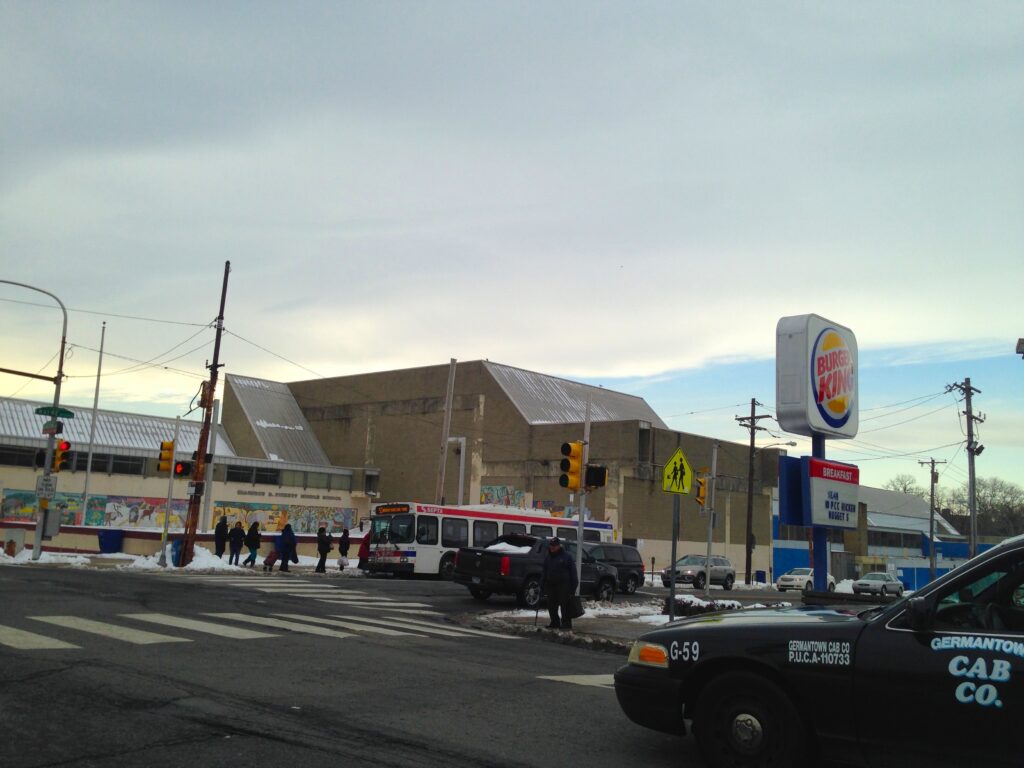
Pictured: Chelten Ave & Wayne Ave in Germantown, listed in a recent report as one of the top 10 intersections in Philly for most pedestrian involved crashes. Photo by Emaleigh Doley.
Councilwoman Bass Introduces Bill to Raise over $3.4 million for Street Calming Efforts
PHILADELPHIA – Today, Councilwoman Cindy Bass (8th District) introduced a bill that will raise an estimated $3.47 million for street calming measures throughout the City of Philadelphia.
The ordinance, which would take effect in July 2016, would add an additional $5 fee to vehicles registered to an address in the City of Philadelphia. Drivers would pay the fee at the time a vehicle is registered or when the registration is renewed.
In 2013, the state legislature passed Act 89, which authorized counties across the Commonwealth to add this fee to registrations. The additional funds would be collected by PennDot and subsequently distributed to the county.
“Every part of our City has been impacted by senseless traffic fatalities,” said Councilwoman Bass. In light of all the traffic deaths and injuries, devoting more resources to slowing cars down will protect all those who use our public thoroughfares—motorists, pedestrians, cyclists, and mass transit riders.”
According to the 2015 Vision Zero report produced by the Bicycle Coalition, Philadelphia has one of the highest rates of pedestrian traffic fatalities in the country. A recent list from the Bicycle Coalition listed three intersections in the 8th Council District: Broad & Olney, Broad & Lehigh, and Chelten & Wayne in the top 10 for most pedestrian involved crashes. The report also highlights an additional $1 billion that traffic crashes cost the City ever year. If passed, the additional funding provided for traffic calming measures like speed cushions will save lives and save money for the City every year.
Since Act 89 went into effect in January 2015, only three counties—Cumberland, Blair and Fulton—have taken advantage of this new measure, which requires a local ordinance to trigger the funding.
“There are certainly more steps for our City to take to reach the goal of zero traffic deaths, but providing additional money for proven street safety measures is a step in the right direction,” Bass added. “We will continue working with the Streets Department and the Police Department to make sure every roadway is safe for motorists and pedestrians alike.”
###
Councilwoman Cindy Bass represents the 8th Council District, which includes Germantown, Mt. Airy, Nicetown, Tioga, Chestnut Hill, portions of Logan, and West Oak Lane. She is Chair of Council’s committee on Parks, Recreation and Cultural Affairs.
Germantown, Philadelphia, PA (October 1, 2015): Germantown United CDC is proud to announce the next round of grantees for the Fund for Germantown, the organization’s micro-grant program supporting community-driven beautification projects in Northwest Philadelphia’s Germantown neighborhood.
Since the program launched, 17 micro-grants have been awarded, with funds supporting a wide range of projects from greening to murals, neighborhood bulletin boards, cleanups and other community-building activities.
Through generous seed-funding by local real estate developers Howard Treatman and Ken Weinstein, Germantown United CDC distributes small grants ranging from $100 to $1000 to local organizations, civic associations, businesses, and individuals seeking to beautify the Germantown neighborhood. The grant program is part of Germantown United CDC’s ongoing efforts to promote and facilitate the revitalization of Germantown’s business corridors through a sustainable, creative, and community-driven approach to economic development.
The focus of the Fund for Germantown is to support projects that will have an immediate physical impact on the neighborhood. The fund provides grants for physical improvements across Germantown including, but not limited to, landscaping, signage, painting, reclaiming empty lots, and waste removal.
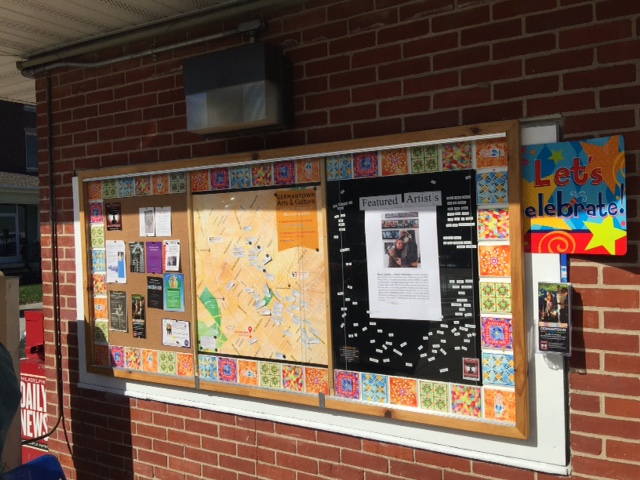
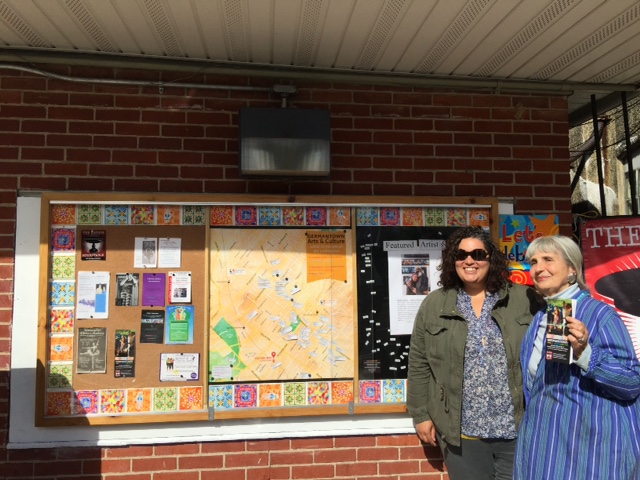
In October, the Germantown Artists Roundtable celebrated the installation of a new arts-focused community message board at the Chelten Avenue SEPTA station, located on Chelten Ave between Pulaski Ave and Morris St. The thematic board, created by the Artists Roundtable, is a Fund for Germantown project, supported by Germantown United CDC. Pictured: Emaleigh Doley, Commercial Corridor Manager, Germantown United CDC, and Paula Paul, Germantown Artists Roundtable.
The latest Fund for Germantown winning projects ideas are:
Artist and photographer Tieshka Smith will launch the Peaceful Places public signage project in Germantown’s storied Penn-Knox neighborhood, next to the Central Germantown business corridor
Fitler Academics Plus, a public elementary school in Germantown serving students in grades one through eight located at 140 W Seymour St (at Knox St) will paint ground murals and organized games in the school’s playground
West Central Germantown Neighbors civic association will enhance their community orchard and garden project at the Tulpehocken Train Station, a SEPTA Regional Rail station at 333 W Tulpehocken St (off Walnut Ln and Wayne Ave)
Support to sustain the ongoing streetscape beautification efforts of Men Who Care of Germantown around their headquarters at 180 East Tulpehocken St (at Morton St)
The Imperfect Gallery will install an interactive sidewalk mural outside of the gallery and community space at 5601 Greene St, adjacent to the Maplewood Mall pedestrian plaza and shopping corridor
Freedom Gardens, a project by Germantown resident Susan Guggenheim, will connect local gardeners who would like to share their crop free of charge with Germantown residents looking to improve their diets with home-grown produce; Freedom Gardens will be identified by lawn signs and online via Google Maps
Support to sustain Chew-Belfield Neighbors Club’s ongoing cleaning and beautification projects in East Germantown
“We are excited to support these small projects that have a big impact”, says funder Ken Weinstein. “These kinds of initiatives are exactly what we had in mind when we envisioned the Fund for Germantown”, said Howard Treatman. “It’s been great to see how Germantown United has been able to empower the community and leverage grassroots efforts.”
This is the third round of giving for the Fund for Germantown, which launched in the summer of 2014 and features two grant cycles per calendar year. The deadline for the next Fund for Germantown grant cycle is December 31, 2015. Funding guidelines may be found on Germantown United’s website at www.germantownunitedcdc.org. To request an application, email [email protected].
ABOUT
Germantown United Community Development Corporation is a 501(c)3 organization that was created to promote and facilitate the revitalization of Germantown’s business corridors through a sustainable, creative, and community-driven approach to economic development. Founded in 2011, Germantown United CDC’s focus is to work with residents, businesses and community organizations to create an inspirational vision of Germantown’s business corridors and surrounding neighborhoods, create innovative case studies and sustainable business models to attract green-oriented developers, and recruit forward-thinking investors committed to fostering sustainable economic growth and development for all Germantown residents.
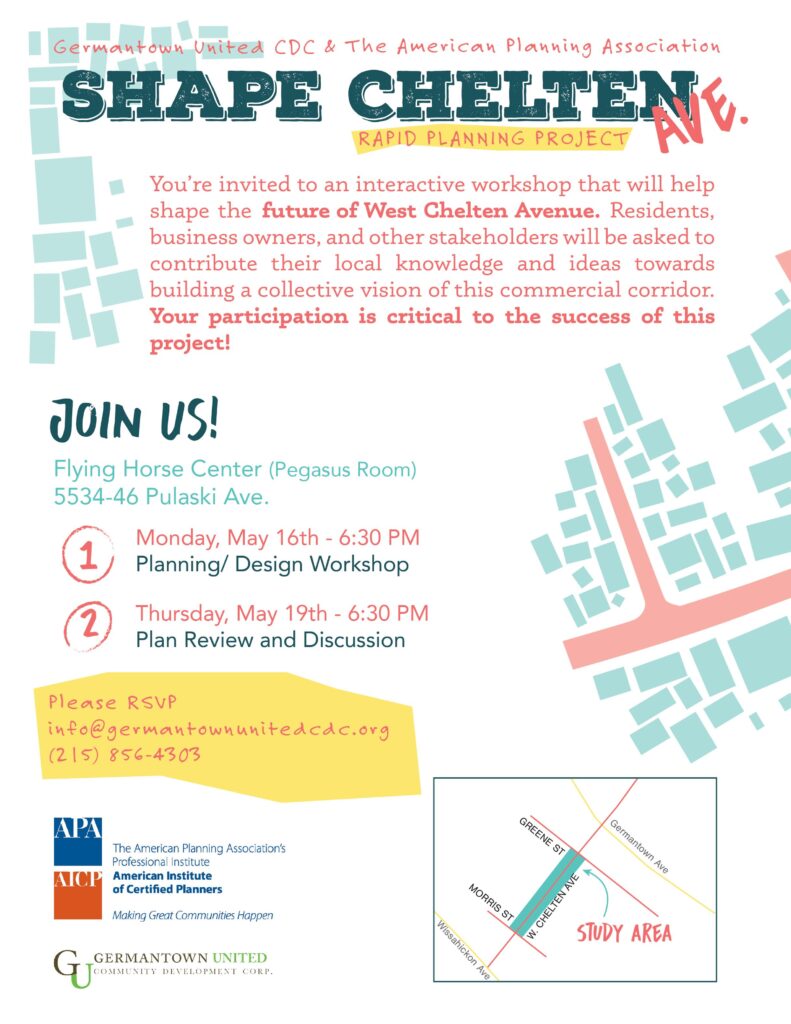
 Germantown United CDC applied for and received the American Planning Association’s Community Planning Assistance Team (CPAT) to conduct a brief and focused planning effort on a small area of Germantown. Since GUCDC’s focus is on commercial corridors, the portion of West Chelten Avenue between Morris Street and Greene Street was selected as the study area.