GERMANTOWN UNITED COMMUNITY DEVELOPMENT CORPORATION WINS PRESERVATION GRANT FROM THE NATIONAL TRUST FOR HISTORIC PRESERVATION & AMERICAN EXPRESS
Germantown wins $160,000 in grant funding from American Express.
PHILADELPHIA — November 6, 2017 … To commemorate the 40th anniversary of the National Trust for Historic Preservation’s work to revitalize America’s Main Streets, the National Trust joined with American Express, National Geographic, and Main Street America for Partners in Preservation: Main Streets, a community-based campaign to raise awareness about the importance of preserving America’s Main Street districts.
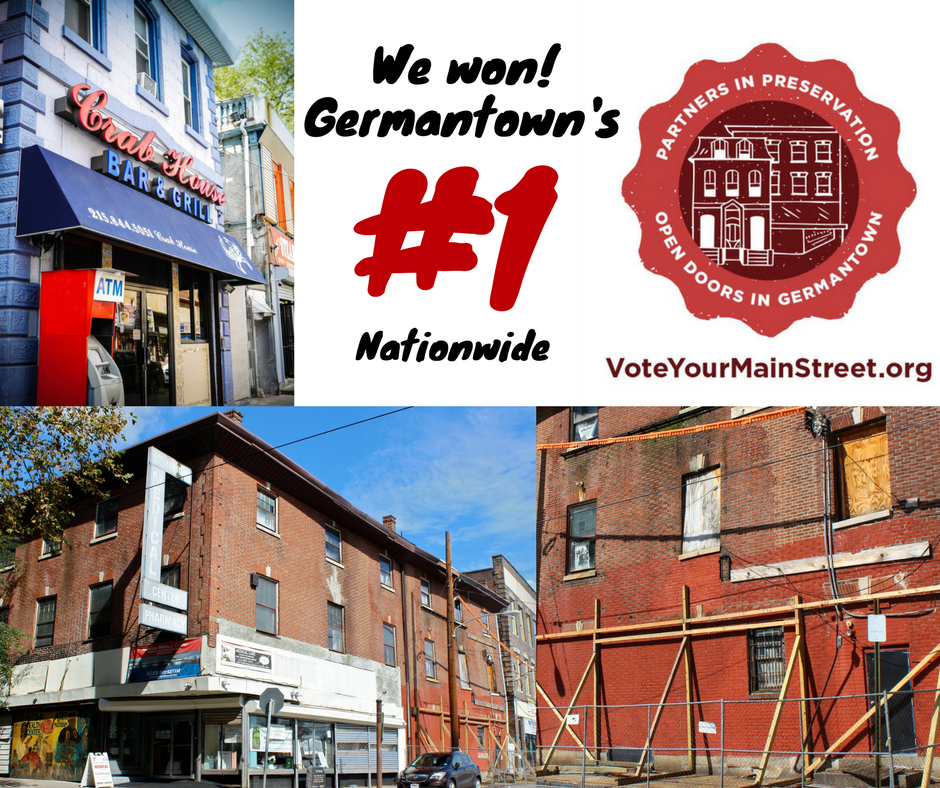
The Open Doors in Germantown project, led by the Germantown United Community Development Corporation, finished in first place out of 25 main street districts in a nationwide popular voting competition from September 25 through October 31, and earned a $150,000 grant for historic preservation. Germantown also won an additional $10,000 grant for increasing its vote total by the highest percentage during a one-week voting challenge.
The 11 winning historic sites will receive a total of $1.5 million in grants to fund their respective preservation projects. An additional $500,000 in grants was provided to the nonprofit partners of the 25 main street communities that participated in the program at the outset of the campaign to help raise awareness about their preservation needs.
The Germantown United Community Development Corporation intends to use the funding to provide structural improvements to two buildings on Germantown Avenue’s business corridor: Parker Hall (5801 Germantown Ave) and John Trower’s building (5706 Germantown Ave), both significant 20th century African-American historic sites. Parker Hall was an integrated social hall that served as a USO-like facility during World War II for African American soldiers. The eponymous John Trower building was operated by a well-known businessman and philanthropist who was considered the wealthiest African-American in the U.S. Both buildings will continue their current uses. Today, Parker Hall contains the office of Dr. Althea Hankins, MD, and the ACES Museum, which pays tribute to multi-ethnic contributions to the U.S. Military in WWII. The museum hosts veterans groups from throughout the country. John Trower’s building is home to the Crab House restaurant, a popular local business
Restoring these facades will benefit these businesses, bolster the historic appeal of Germantown, and increase community pride by highlighting the contributions of African-Americans to the history and culture of this country, in an underserved African-American urban community.
Germantown United CDC’s mission is to promote and facilitate the revitalization of Germantown and it’s business corridors through a sustainable, creative and community driven approach to economic development. GUCDC believes that Germantown’s history and built environment are economic assets upon which to rebuild Germantown’s economy and create equitable economic development. After decades of decline, there are signs of improvement and vibrancy in Germantown.
Why Main Street Matters
According to 2016 data from Main Street America, investments in Main Street districts have a significant impact on local economies – encouraging real estate development as well as the creation of new businesses and jobs. In 2016, $4.65 billion reinvested in Main Street improvement programs resulted in 8,042 building rehabilitations, 5,616 business openings, and 27,462 new jobs.
Furthermore, according to a recent study from Morning Consult of 2,201 Americans commissioned by American Express, 79 percent of Americans say that preserving Main Street is important. Additionally, 79 percent of Americans say that the idea of Main Street is what makes America beautiful. Main Street is also seen as vital in connecting Americans to their local community – 82 percent of Americans say that Main Street is important to their ability to socialize with others in a community. A similar amount, 86 percent, say that Main Street is important to the well-being and the enjoyment of a community.
For more information and to vote daily for Germantown United CDC through October 31, visit VoteYourMainStreet.org and share the love via social media using #VoteYourMainStreet and #VoteGermantown.
###
About Germantown United Community Development Corporation
The mission of Germantown United Community Development Corporation (GUCDC) is to promote and facilitate the revitalization of Northwest Philadelphia’s Germantown neighborhood and its business corridors through a sustainable, creative, and community-driven approach to economic development. Learn more at http://germantownunitedcdc.org/.
About Partners in Preservation
Partners in Preservation is a program in which American Express, in partnership with the National Trust for Historic Preservation, awards preservation grants to historic places across the country.
Through this partnership, American Express and the National Trust for Historic Preservation seek to increase the public’s awareness of the importance of historic preservation in the United States and to preserve America’s historic and cultural places. The program also hopes to inspire long-term support from local citizens for the historic places at the heart of their communities.
About the National Trust for Historic Preservation
The National Trust for Historic Preservation, a privately funded nonprofit organization, works to save America’s historic places: www.savingplaces.org.
About Main Street America
Main Street America has been helping revitalize older and historic commercial districts for more than 35 years. Today it is a network of more than 1,600 neighborhoods and communities, rural and urban, who share both a commitment to place and to building stronger communities through preservation-based economic development. Main Street America is a program of the nonprofit National Main Street Center, Inc., a subsidiary of the National Trust for Historic Preservation.
About National Geographic Partners LLC
National Geographic Partners LLC, a joint venture between National Geographic Society and 21st Century Fox, combines National Geographic television channels with National Geographic’s media and consumer-oriented assets, including National Geographic magazines; National Geographic Studios; related digital and social media platforms; books; maps; children’s media; and ancillary activities that include travel, global experiences and events, archival sales, catalog, licensing and e-commerce businesses. A portion of the proceeds from National Geographic Partners LLC will be used to fund science, exploration, conservation and education through significant ongoing contributions to the work of the National Geographic Society. For more information, visit http://www.nationalgeographic.com/ and find us on Facebook, Twitter, Instagram, Google+, YouTube, LinkedIn and Pinterest.
The group Germantown United CDC, founded last year, is trying to change things. “Germantown is an incredible neighborhood, with endless historical and cultural assets,” says Emaleigh Doley, a Germantown resident and member of the Germantown United CDC’s steering committee. “It’s true that over the years, the neighborhood has taken a hit, to put it mildly. Now, if ever, is the time for Germantown to move forward.” Doley is encouraged by what she’s seen: a steady rise in community organizing, citizen planning and participation in development issues. “It’s development of the neighborhood’s business corridors and blighted and vacant land that will play a major role in shaping Germantown’s future,” she says, “which is why Germantown United CDC’s focus begins with sustainable commercial corridor development. We want to see business districts operating at their fullest potential, facilitating further redevelopment in Germantown and stimulating economic growth.”
Check out Inquirer Article on one of the panelists for GUCDC’s Sustainability Forum
Germantown resident turns cleanup artist
By Karen Heller, Inquirer Columnist
POSTED: April 08, 2013
Zack Bird paints walls. He does pretty well creating murals and faux finishes for Palm steak joints across the country, and in some of the nicer homes across the region.
Bird has a second, stealth job unpainting walls.
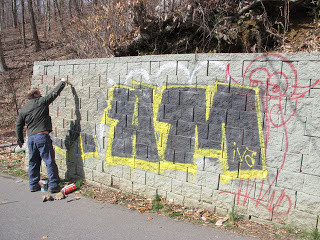
Specifically, he paints over graffiti on walls and bridges in public spaces, along the river drives, and in the Wissahickon, “the thing I love most about Philadelphia.” Call it faux unfinishing.
It’s his one-man beautification project. Instead of Lady Bird, we have Zack Bird.
“I’m just doing my little part,” said Bird, 43, the son of two artists, who grew up in Mount Airy and now resides one neighborhood over in Germantown. “How can you grow up near the Wissahickon and not be entranced with the stonework?”
So this is a story that reveals how one person doing one thing is helping the city and making our lives better.
Bird has taken his talent and applied it, literally, for free to restoring what was. “I don’t want to compete with graffiti artists, although the art hasn’t developed much in the last 20 years,” he said. “But I want it out of the parks. It’s an eyesore. They’re vandals, not artists. There’s nothing cool about defacing other works of art and public property.”
Since December, Bird has completed a dozen reclamation projects, along Kelly and Lincoln Drives, a retaining wall near Cresheim Creek,
(Inquirer)
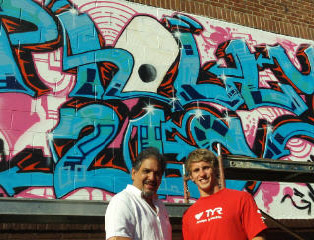
With most of the 55,000-square-foot facility leased and the final phase of office flex space being built, owner Stan Smith is once again using the hulking structure as a leading example of how to combat some of Philly’s chronic urban woes. This time he’s taking on another form of neighborhood blight: graffiti. In a page out of Jane Golden’s playbook, he’s allowing local artists to use portions of the Flying Horse Center’s facade as a showcase for street art.
“The building gets so much exposure because of its central location right next to the train stop,” explains Smith. “The graffiti that plagued the building was sending the wrong message. It made me mad.”
Everything You Need to Know, Past and Present, To Understand the City’s Plan to Redevelop Over 100+ Units of Housing in Germantown
On May 10, the Philadelphia Housing Development Corporation (PHDC) hosted its second community meeting about a large redevelopment project impacting the Germantown neighborhood. The extensive portfolio of properties discussed, listed here on PHDC’s project page for the initiative, includes 24 buildings located in the Germantown neighborhood and 2 in Mount Airy. Within the structures, there are reportedly 114 units of housing.
We are talking about more than two dozen publicly owned properties that will be redeveloped. The properties are a mix of vacant and occupied apartment buildings and single-family homes, initially developed to supply community members who are low-income with more affordable housing options.
The City has dubbed this effort the “Germantown and Mt. Airy Redevelopment Initiative.” That title and the total number of individual properties under discussion is a bit misleading. Practically all of the properties are located in clusters in Lower Germantown, on the east side of Germantown Avenue nearby the Freedom Plaza shopping center.
WHO OWNS THE PROPERTIES & WHERE ARE THEY?
The Philadelphia Redevelopment Authority (PRA) is the city agency that owns the properties. In January 2020, the courts awarded possession of the properties to PRA, after two years of litigation. The properties were previously owned by Greater Germantown Housing Development Corporation (GGHDC),the development arm of the now defunct social service nonprofit Germantown Settlement.
PROPERTY LIST
This list was copied from the City’s project page for the initiative. On the website, you will find updates about the project, a schedule of community meetings, and extensive property reports for each structure. By extensive, the reports average 70 to 100+ pages each. It’s not light reading! We recommend that community members read the Physical Conditions & Needs Assessment (PCNA) Executive Summary which clocks in at a manageable nine pages.
Note, a member of the Steering Committee for the project pointed out at the May 10 community meeting that this list does not seem to include all of the properties that were part of the foreclosure in 2018. The PRA was asked to address this, updates forthcoming. It was also noted by an attendee that the total number of individual units seems to fluctuate depending on what report you look at.
UNDERSTANDING WHAT’S HAPPENING RIGHT NOW
Who are the players, Scheduled community meetings, What happens next
The PRA is working with PHDC who is working with a team of consultants to lead a community engagement process inviting residents to contribute to the redevelopment plans. Their stated goal is to ensure that these properties are responsibly developed in the best interest of the community.
As part of the engagement process, PHDC is asking you – Germantown and Mount Airy residents, current and former tenants – what you want done with these properties, who should develop them, who should own them, and for whom they should be developed.
WHO’S WHO
The Philadelphia Redevelopment Authority now owns and controls the properties that are part of this initiative. The PRA is the City of Philadelphia’s implementation arm for community development, and works closely with government officials and developers to assemble, transfer, and sell city-owned properties and land for redevelopment. They are advisors to the City and its agencies, including: Division of Housing and Community Development, Philadelphia Housing Development Corporation, Philadelphia Land Bank, Philadelphia Commerce Department, Philadelphia City Planning Commission, and Philadelphia Housing Authority.
The Philadelphia Housing Development Corporation, a partner agency to the PRA, is managing the community engagement process on the PRA’s behalf. PHDC is similar to a community development corporation (CDC) for the entire city. They work in every neighborhood in Philadelphia, help communities plan, and help residents, community groups, businesses and developers repurpose vacant property and land.
BFW Group was hired by the PRA to provide a physical conditions and capital needs assessment report for all of the properties that are part of this initiative. BFW Group is a consultant group that responded to the City’s Request for Proposals (RFP) and was selected for the job. They have a contract with the City. BFW’s partners are LAN Associates, Maple Corporation, Criterion, and Mark Ulrick Engineers, Inc.
Maple Corporation is working with BFW Group as a consultant. They are the most public-facing group that is engaging with community members. It is our understanding that Maple Corporation is responsible for organizing the outreach effort and leading the public community meetings.
COMMUNITY MEETINGS
A schedule of community meetings is posted on the project page.
The purpose of the community meetings was not entirely clear at the outset. The intent of the meetings is to solicit ideas from residents, current and past tenants, and other community stakeholders. Maple Corporation’s role is to provide structure for the meetings, recording all input from attendees, assembling the information and delivering a report to PHDC documenting and summarizing the entire process. Maple Corporation is not responsible for determining what will happen with the properties.
As of this posting, two of the three meetings have taken place. The first meeting was held on April 28 (virtual only). The second meeting was held on May 10 in-person and virtual. The third and final meeting is currently scheduled for Saturday, June 18, 12-4pm in-person at LaSalle University Founders Hall Auditorium (5698 Wister Street, 19144) and virtual. Maple Corporation also held a meeting with Registered Community Organization’s (RCOs) on April 14, as a courtesy to introduce the groups to the project.
Lastly, Maple Corporation is working with a Steering Committee formed for the initiative. A list of the Steering Committee members is available here. It is not clear how the Steering Committee was formed and what role they will play–the consultants have said that it was ‘assembled by the City’ with no other detail provided. It is also unclear if all of the input provided by participants in the public meetings will actually be represented in Maple Corporation’s final report. In the engagement plan shared by Maple Corporation with the RCOs ahead of the April meeting, it states: “The alternative redevelopment options suggested by the community will be reviewed by a Steering Committee. The Steering Committee will be instrumental in capturing and accurately representing community feedback. Thereafter, the community feedback will be submitted to the Philadelphia Redevelopment Authority.” We understand there will be repetition in the feedback provided and that the information will likely be condensed and consolidated. However, it is not clear if the Steering Committee will be prioritizing or eliminating recommendations. We ask that a full record of the community’s contributions be included in the report and made publicly available.
For full disclosure, Germantown United CDC requested to have a representative on the Steering Committee back in February 2022 and pledged to support PHDC’s work where needed. A second request was made in April 2022. The requests for a role on the Steering Committee went unanswered. At the very least, we asked that we be kept up-to-speed so that we could contribute to the process and share important information through our community network.
It is not known if additional meetings will be scheduled or if there will be other opportunities to engage. At the April 28 meeting, one of the consultants said they were under “intense pressure” from the City to “get this done.”
An image of the initial door hanger that was distributed to near neighbors. One of the consultants on the project shared that another round of hangers were being printed, and the revised hangers would include the locations and times of the next meetings, a phone number for people to reach out to, and an option to register via phone for those without internet.
WHAT IS NEXT
It is the opinion of Germantown United CDC that outreach to the Germantown community about the public meetings and engagement process has been inadequate, and that the process feels rushed and ill-considered. We have listened to many community members, including leaders of civic and block associations and residents who live within the epicenter of the most affected areas, who have raised concerns about the process, lack of community awareness, and current conditions of the properties.
It is clear from meeting attendance that individuals whose quality of life has been directly impacted by this situation were not effectively engaged. It is unclear if current and past tenants were directly invited to participate in the meetings by PHDC–we owe them that.
Brothers Tony Pointer (left) and Leroy Prince lived in the Hamill Mill II apartments, pictured in 2018. Prince said he had to heat water on his stove for bathing. Read the full story. Photo by Emma Lee for WHYY.
To be fair, the entities that were hired to lead the community engagement process seem to be on their own. Maple Corporation, BFW Group, LAN Associates and others are working for City agencies–PHDC and PRA. Yet leadership from PHDC and the PRA have been noticeably absent from all of the community meetings thus far.
Countless city-related, historical, and technical questions have gone unanswered due to the lack of participation from PHDC and PRA staff in this process. This is an insult to community members who have given over their time to contribute to this process. I myself have participated in 8+ hours of official meetings for this initiative to date. At these meetings, the facilitators have repeatedly stated that they cannot speak to this or that, that they were not hired to do this or that, etc. It would seem that they were setup to bear the brunt of a frustrated community’s wrath. Germantown deserves more.
In addition to requesting membership on the Steering Committee, GU wrote with numerous suggestions for community engagement and promotion and recommended groups to connect with (like the Germantown Masjid, Wakefield 49ers, and Elders Place). After the second meeting, we attended the PRA Board Meeting scheduled for May 11 and requested in writing a number of things that may benefit this process going forward. A summary of our requests follows below:
Secure staff from PHDC, PRA, and other relevant departments to attend and participate in all future meetings. These representatives should be prepared to answer technical questions, comment on what has occurred in the past, and the process moving forward.
Issue a brief survey, both online and available in print, for community members to provide their input outside of the public meeting format. Collect responses for at minimum one month.
Immediately reschedule the meeting scheduled for June 18. The annual Juneteenth Festival organized by Johnson House Historic Site is one of many large community events taking place in Germantown commemorating Juneteenth. Other known events include programs at Vernon Park and Maplewood Mall. This meeting is scheduled on the same day and at the same time as these significant community-wide events.
More of an effort should be made to engage current and past tenants and a special meeting should be scheduled for them. It is known that many of these people were mistreated and have been harmed by this ongoing saga; they should be prioritized.
If PHDC and PRA commit to improving this engagement process, and reschedule the third public meeting, we ask that promotion of any remaining opportunities for engagement be improved. The following are recommended: Create an easily digestible flyer that summarizes the key issues and purpose of this initiative; Provide stakeholders with digital and print copies of the promotional materials for circulation; Publish all materials and any other related updates on PHDC’s project page for the initiative, in PHDC’s email newsletter and across PHDC’s social media channels. The Facebook page created for the project does not have a substantial audience and comments have gone unanswered. Lastly, participants in previous meetings should be directly notified of future opportunities for engagement; the consultants have names and contact information for the majority of attendees since advance registration was requested.
Continue to update the PHDC project page during this process. For example, it says recordings of past meetings will be posted, though a link to the first meeting was not yet available at the time of publication.
Publicize a timeline for the disposition of the properties and their redevelopment, even if it is rough and subject to change. We assume that information will be released after the conclusion of this engagement process, but the community currently has no sense of the timeline we are working within now.
At some point, these properties will come up for sale. It’s been made clear that the City does not want them. The PRA will likely issue another Request for Proposal (RFP) that details how the properties will be sold and the scope of work. PHDC, PRA, and the Germantown community have the power to influence what goes into the RFP(s), and the redevelopment of these buildings, even in the private market.
To get a sense of what a Request for Proposals from the PRA looks like, check out the RFP for the former Germantown YWCA (5820-24 Germantown Avenue) issued in July 2016. While this is not the greatest example of a successful project, we are sharing this because its familiar. This property is unfortunately back in the news. The PRA ended its contract with the development firm that was selected to renovate the property due to inaction on their part. The building is back in limbo, still vacant and undeveloped. For updates on the YWCA, follow the Friends for the Restoration of the Germantown YWCA Building on Facebook.
HOW DID WE EVEN GET HERE?
This is a long and winding story. Some people do not want to talk about it and would prefer to look forward. Others will say, ‘Never forget.’ While there is no definitive history on this matter, it is important to understand who was harmed so that things can be made right, grievances can be addressed, and we as a community can guard against devastating debacles such as this.
To that end, and to provide some context, here is a brief background. Please understand that this is not the whole story, merely what we could put together in short order, starting in 2010.
As mentioned previously, the properties that PRA is seeking to redevelop, that we are talking about now, were once owned and managed by the nonprofit Germantown Settlement. Settlement, which also operated Greater Germantown Housing Development Corporation (GGHDC), ceased operations in 2010 when a federal bankruptcy judge ordered the 125-year old organization to liquidate all of its assets, in part because Settlement had mismanaged millions of taxpayer dollars in it’s latter years.
Settlement received millions of dollars to build and maintain affordable housing from the city and millions more in federal loans. The group also operated a charter school that eventually lost its accreditation with the Philadelphia School District. As Settlement dissolved, Emanuel Freeman, the President & CEO of the nonprofit, managed to appropriate and retain control of dozens of properties from Settlement’s real estate portfolio, properties that should have been liquidated as part of the bankruptcy.
In more recent years, many of the misappropriated properties fell into deep disrepair. Some were abandoned, costing the neighborhood needed affordable housing. Some remained occupied. Rent was being collected all the while, even as residents suffered.
These blighted properties have plagued the Germantown neighborhood.
Garbage is piled in front of an apartment complex in Lower Germantown, pictured in 2018. Read the full story. Photo by Emma Lee for WHYY.
In 2016, Action News ran an investigative report about residents at the Hamill Mill Apartments, located on the 200 block of East Church Lane, who had been without heat for months. This was 6 years after the bankruptcy of Germantown Settlement. So it was not a secret that there was ‘landlord’ negligence and mismanagement, that tenants were struggling and living in squalid conditions. This was on television.
There are many theories about why local government officials and city agencies chose not to act with urgency during this time. Whatever the reasons, it was an extraordinary failure of government, an obvious financial and government scandal, with harm brought to citizens. It is still our hope that a proper investigation of this matter takes place, that those in the private and public sector are held responsible, that a more wholistic and intentional effort is made by the city and state to prevent such a disaster from ever happening again, that plans to mitigate the fallout and effects on communities in future is thoughtfully considered.
Fast forward to 2018.
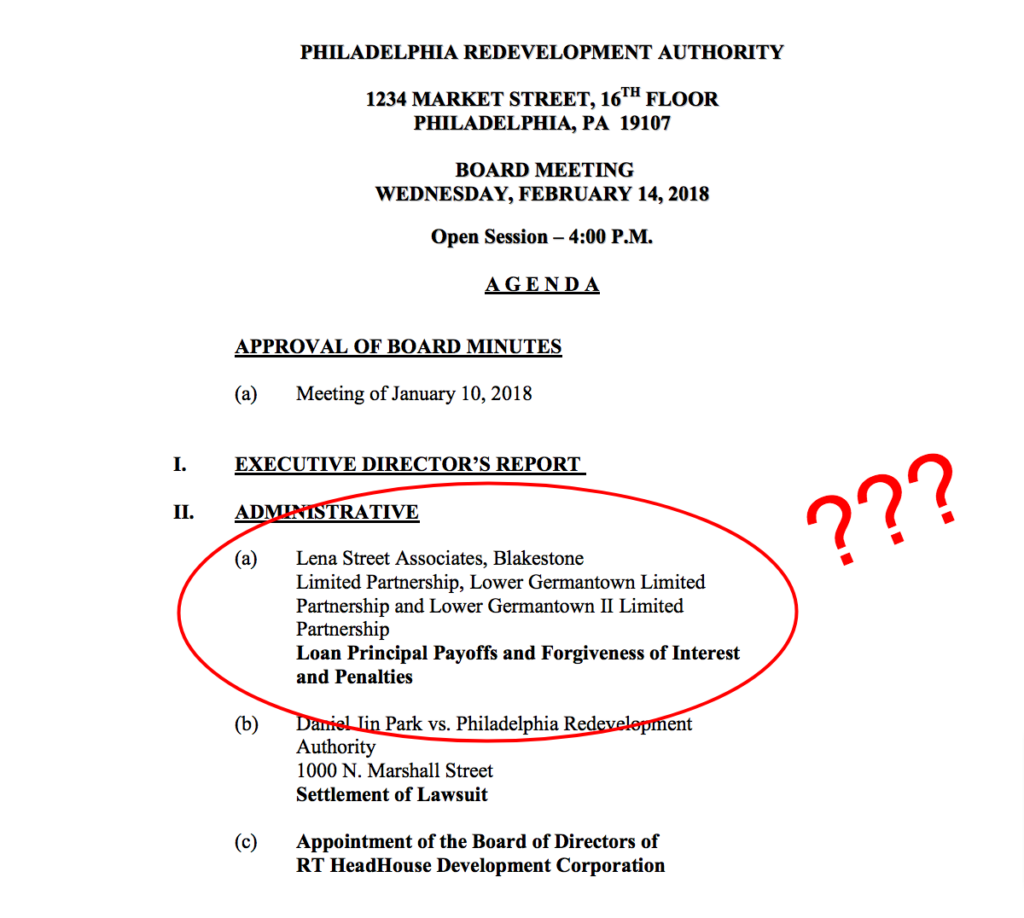
Allison Weiss, a community organizer and business owner active in Germantown, noticed something strange listed on the Agenda for the February 14, 2018 meeting of the Philadelphia Redevelopment Authority Board of Directors. The PRA Board was seriously considering an offer from Mr. Freeman to payoff $3.5 million in loans in return for forgiveness of $5 million in interest and penalties. This is now 8 years after the bankruptcy of Germantown Settlement, which again should have included the very properties that were now under the control of Freeman. At this point, Germantown Settlement no longer existed; it was an individual, his family, and associates who were wrongly in possession of these properties and essentially acting as slumlords to vulnerable people in Germantown.
A screenshot of the Agenda for the February 14, 2018 meeting of the Philadelphia Redevelopment Authority Board of Directors.
On February 14, Mr. Freeman himself appeared before the PRA Board to present his proposal. He had secured a lender and the closing was scheduled for the next day, he said. He asked the Board for same-day approval, citing several factors requiring urgency, and stated that with the Board’s approval he could proceed with stabilizing and rehabilitating the properties, which were developed as “part of a 1992 project” he led (under Germantown Settlement, which was not named). It was noted by PRA staff member Ryan D. Harmon that PRA was the first lienholder on a majority of the properties. This gave the PRA the option to foreclose on the properties with Authority loans.
It was also noted that if a foreclosure action was not filed by the PRA, it could result in a sale of the properties based on other liens with other lienholders. In other words, there are other lenders that are owed money. If the Board approved Mr. Freeman’s proposal that day, then there was a chance that the PRA could see a return on their initial investment; and, if they delayed or rejected the proposal, there would likely be no recovery on the PRA mortgages. In this scenario, the PRA would eat the loss. The Germantown neighborhood, crippled by this state of affairs, had already lost big, a fact not acknowledged by Mr. Freeman or the PRA.
Three women involved in community improvement efforts in Germantown were also at the meeting – Allison Weiss, who discovered that Mr. Freeman’s proposal was under consideration, Yvonne Haskins, and Connie Winters. They came to stand up for Germantown. In their testimonies, which you can read word for word in the minutes of the March 14 board package, they urged the PRA to “do the right thing.” They shed light on the deteriorating conditions of the properties, issues of questionable ownership, and mistreatment of current tenants. They firmly asked that the Board reject the proposal. Dr. Erwin Carter, who claimed to own 40% of the portfolio being discussed, testified on behalf of Mr. Freeman. Dr. Carner asked the Board to give Mr. Freeman and him the helping hand that they need. The Board then went into Executive Session. When the Board returned, they shared that a determination was made to table this item until the following information was presented by Mr. Freeman: “title commitments, plans and financials relative to the construction loan including, but not limited to, a scope of construction, a plan of management, a corresponding budget including line-item construction costs for each address, sources and uses, cash flow statement and operating proforma.” They also offered to schedule a Special Board meeting prior to the March scheduled meeting if materials were provided to the Board’s satisfaction.
This saga is well-preserved in the agendas and minutes for PRA board meetings from this time:
March 14, 2018 Board Meeting See pgs. 4-7, which includes testimony from Mr. Freeman and public comment from local stakeholders Item II (a) on pgs. 18-20 is a Fact Sheet prepared for the Board by PRA staff that reviews the history of the loans in question
After public outcry, PRA ultimately rejected Mr. Freeman’s proposal.
Given the known history, it was shocking to learn that a government agency was again negotiating with Mr. Freeman. “We were about to make a mistake. We should have done more due diligence. We didn’t. But we stopped it,” said then City Director of Planning and Development Anne Fadullon at a packed community meeting in Germantown at Tabernacle Haitian of Philadelphia that was organized by members of the community in April 2018. “We heard you and said ‘Okay, this is a bad actor, we’re not playing with that bad actor anymore.’”
Citizens stopped the PRA from further enabling an individual with a private interest to continue profiting off of misappropriated properties and harming low-income residents of Germantown. This in and of itself shows that there were numerous ‘bad actors’ who contributed to this problem. It was not just one man.
Active members of the community continued to organize under the name Justice for Germantown, came out to PRA meetings, and insisted on change. When the news media picked up the story, community concerns were further validated.
A flyer created by Germantown residents to advertise a community-organized meeting held on May 8, 2018. Download a PDF copy.
The PRA set out to seize the blighted properties in 2018.
The PRA filed foreclosure paperwork and petitions to secure emergency receivership of the properties in the Court of Common Pleas. With an emergency receivership, the receiver is legally able to rehabilitate or stabilize a property that has been seriously neglected by the owner, providing tenants and neighborhoods the security and safety they deserve. The “horrible conditions” of the publicly subsidized affordable housing developments demanded “extraordinary” action, said Gregory Heller, then Executive Director of the PRA. “Tenants were living in uninhabitable spaces. They needed help from the public sector,” Heller said to a WHYY reporter.
Margaret Scott outside the house she began renting from Germantown Settlement 26+ years ago. In April 2018, she told a reporter with the Philadelphia Inquirer that no one had done any repairs for years. Read the full story. Photo by David Maialetti for the Inquirer.
After a two-year court battle against Mr. Freeman and associates, PRA gained ownership of the properties in 2020.
In 2021, the PRA commissioned an assessment of the properties, hiring BFW Group to document existing conditions of the units to determine critical repair items, short- and long-term physical needs and cost estimates for the structures. A summary of the physical conditions and needs assessment and individual reports for each property is available on PHDC’s project page for the Germantown and Mt. Airy Redevelopment Initiative.
It is now 2022, 12 years since the bankruptcy of Germantown Settlement.
This speaks to the need for smarter, compassionate, transparent, and more efficient ways for city agencies responsible for supporting low-income communities, predominantly Black people and other communities of color, to serve them better.
Germantown is owed. Germantown deserves more.
RELATED NEWSSTORIES
Included below are links to some articles that provide good background info. This blog post was in part informed by these resources.
Germantown United CDC will work to stay informed about this initiative, and will continue to be an active participant in future meetings about these properties, and share updates with the greater Germantown community through our own communications channels.
PEOPLE YOU CAN CONTACT
If you have comments or questions about this initiative please participate in the meetings. You may also reach out to the following contacts directly.
Angel Rodriguez, Senior Vice President, Land Management, Philadelphia Land Bank Executive Director, Philadelphia Redevelopment Authority Deputy Executive Director, [email protected]
Ryan Ambrose, Director, Neighborhood Preservation Initiative, [email protected]
Philadelphia Redevelopment Authority Board of Directors The PRA’s board meets monthly. A list of members and the meeting schedule is posted here. The chair of the board is David S. Thomas (contact info above). Community members are encouraged to attend these meetings, currently offered via Zoom. There is opportunity for public comment.
Cindy Bass, Councilmember for the 8th District Councilmember Bass represents the Germantown neighborhood. Contact info for this office follows: City Hall: 215-686-3424, 215-686-3425 District Office: 215-685-9182, 215-685-9183 Cindy Bass, Councilmember, [email protected] Antoinette Johnson, Chief of Staff, [email protected] Charles Richardson, Director of Constituent Services, [email protected]
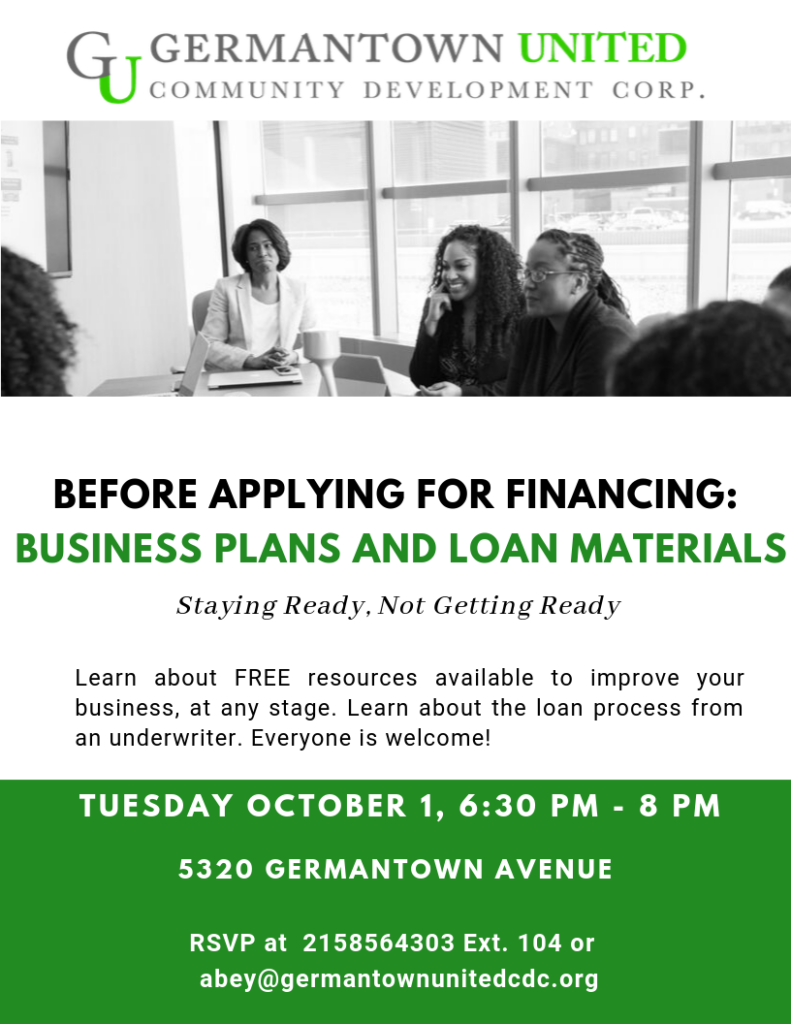
Learn from the loan officers and business coaches about FREE resources available to you in person and online to improve your business. Curious about steps you need to take before applying for loans and grants? Stay ready instead of getting ready! Come talk to us on Tuesday, October 1, 2019! More info below.
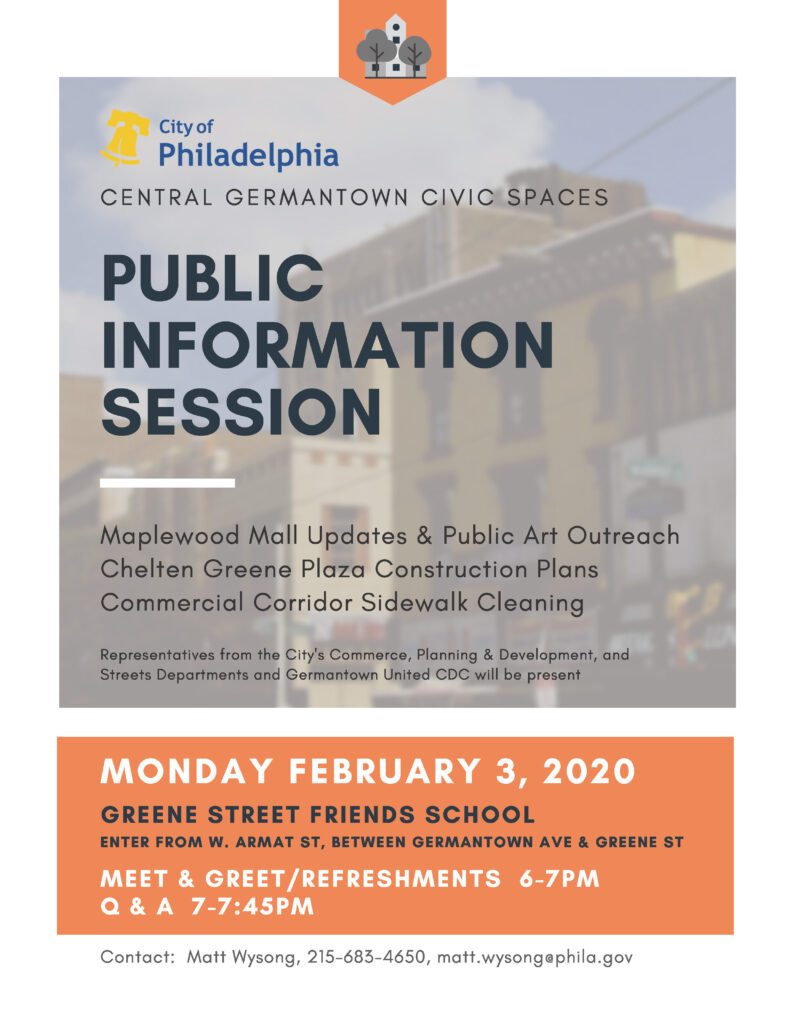
Meeting Announcement: There’s a lot going on in Central Germantown these days! Wanna be in the know? Come to our Public Information Session on Monday, February 3, 2020 from 6pm to 7:45pm.
What to Expect:
Get updates on Maplewood Mall construction activities
Contribute to Maplewood Mall’s public art project
See plans and get information on upcoming construction for the Chelten Greene Plaza project
Learn about sidewalk cleaning efforts
Meet staff from the City’s Commerce, Planning & Development, and Streets Departments; and Germantown United CDC
Ask Questions, Get Answers.
Location: Greene Street Friends School (enter from Armat Street, between Germantown Ave and Greene St) Contact: Matt Wysong, 215-683-4650, [email protected]
On behalf of the Germantown United CDC’s board and staff I would like to share an update with regards to our Executive Director, Andrew Trackman. Earlier this fall Andy took a leave from Germantown United CDC to deal with a medical issue. We are pleased to share that Andy has been released from the hospital and is getting stronger day-by-day, but his recovery will continue to take time, rest and rehabilitation.
During his leave, Emaleigh Doley, Deputy Director, will be the point person for external requests and issues. Fiduciary matters will remain in the hands of the Board of Trustees. ln Andy’s absence, trustees and GUCDC’s dedicated and experienced staff are well-prepared to keep the organization on course with its current operations and vision.
We wish Andy a speedy recovery and appreciate everyone’s support through this challenging time.
For concerns, please contact the Germantown United CDC office at 215-856-4303 or [email protected].
Update 10/31/19: The Maplewood Mall Reconstruction project groundbreaking ceremony scheduled for Oct. 31st has been canceled due to the weather.
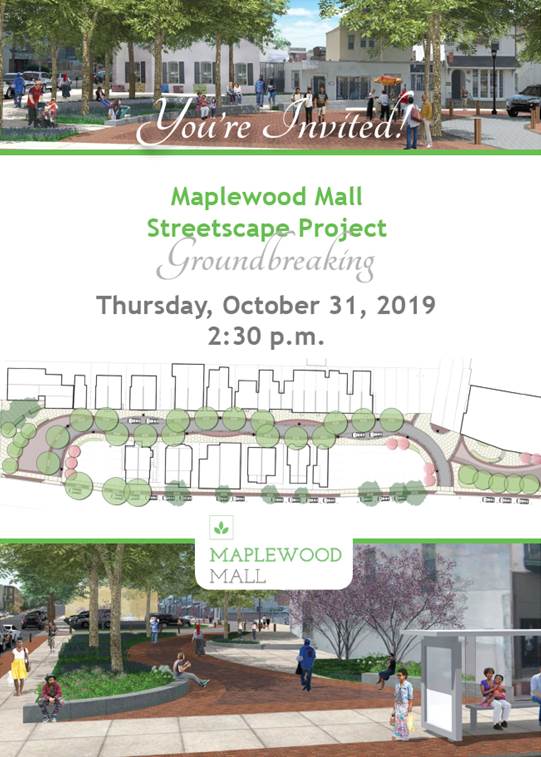
The City of Philadelphia is rebuilding the roadway, sidewalks, and plazas of Maplewood Mall. A ceremonial groundbreaking for Maplewood Mall Reconstruction project will be held on Thursday, October 31, 2:30pm. This is a public event, and elected and City officials will be in attendance.
Germantown United CDC has setup a Maplewood Mall Reconstruction project page for the community where you can find up-to-date information on the project. The media advisory from the Mayor’s Office of Communications follows below.
MEDIA ADVISORY Groundbreaking Kicks Off Maplewood Mall Reconstruction Central Germantown’s popular meeting place gets a makeover
WHO: City officials, Germantown residents, and Maplewood Mall business owners come together to kick off the Maplewood Mall reconstruction project. The rehabilitated mall will contribute to the revitalization of Central Germantown and serve as a gathering space for all community members.
Speakers:
Mayor Jim Kenney
Councilmember Cindy Bass
Anne Fadullon, Director of Planning and Development, City of Philadelphia
A local business owner
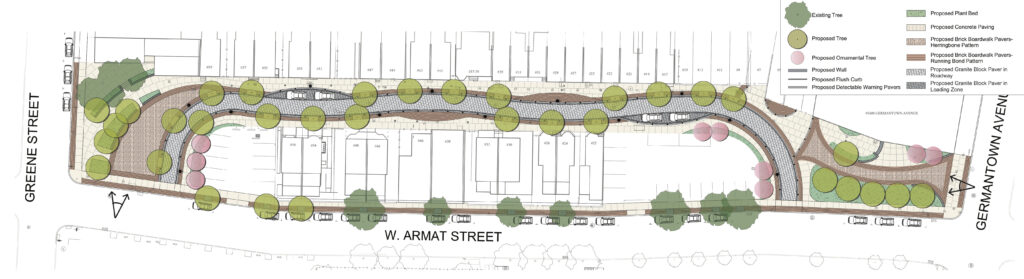
WHAT: The mall improvements are part of the City’s ongoing investment in Germantown. Renovations include new seating, pedestrian lights, sidewalks with street trees, landscaping, bicycle racks and public art. The roadway will be reconstructed and new water mains installed. The project will help to increase customers for Maplewood businesses and create employment opportunities for residents.
WHEN: Thursday, October 31, 2019, at 2:30 p.m.
WHERE: Intersection of Maplewood Mall and Armat Street, between Germantown Avenue and Greene Street
DETAILS: This event is open to the public and the press.
During the Maplewood Mall Reconstruction project access to the businesses on the street, and the general unsightliness of a construction site, may be a hindrance to businesses’ ability to attract customers and foot traffic. Germantown United CDC is contracted to advertise the Mall as “open for business” during construction and will be providing marketing and advertising support specifically to businesses on the Mall.
The marketing campaign will feature professionally designed and customized materials, including:
Print brochures/postcards/flyers
Sign fabrication and installation (street signage/banners)
Social media and print advertising
Work on the marketing campaign is set to begin in November 2019. The organization applied for and received a Corridor Enhancement Grant from the Department of Commerce specifically to support this campaign.


 MEDIA ADVISORY