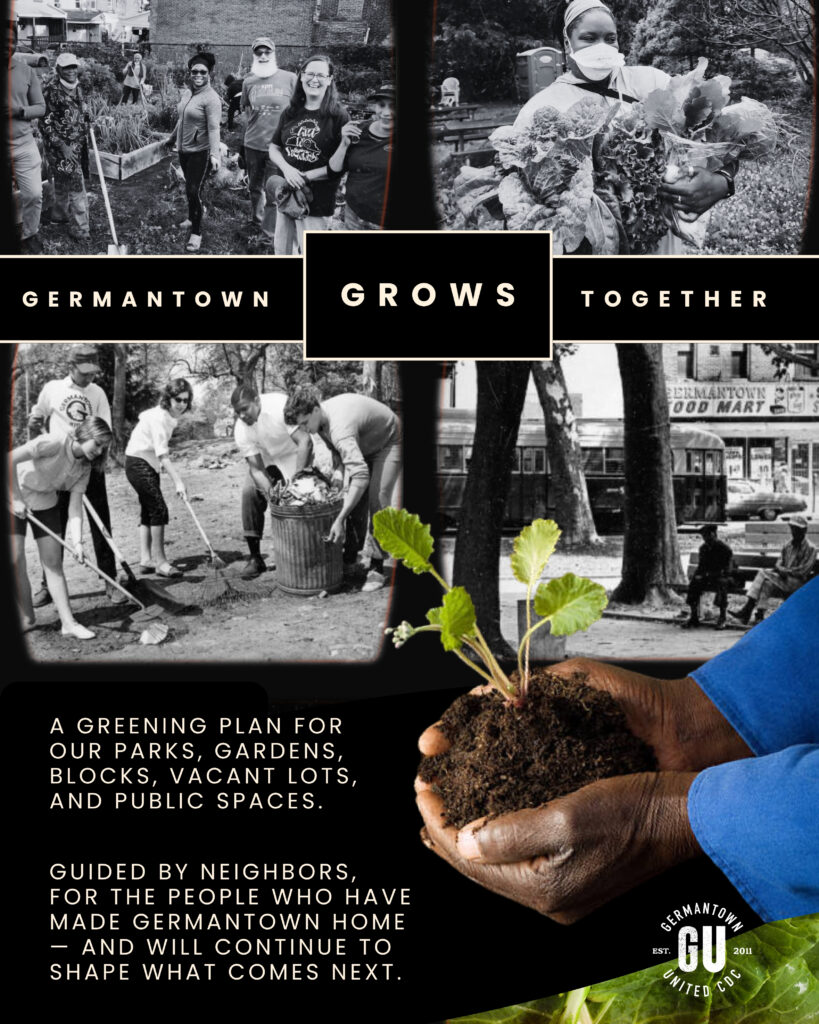
Germantown Grows Together is an 18-month, neighborhood-wide resident engagement and planning process to work with Germantown residents on a vision for a healthier, cleaner, greener, and more livable Germantown. Germantown United CDC will lead this initiative, to help create a Community Greening Plan for Germantown—grounded in equity and belonging—that considers new greening opportunities alongside existing neighborhood assets and housing stability.
The core of the project is resident engagement: listening to residents, gathering input, building trust, supporting participation, and making sure residents help define what neighborhood improvement should look like.
The process will create space for residents to discuss everyday quality-of-life issues that may include:
This plan is about increasing access to greenspace, while making sure current residents can remain and benefit from neighborhood improvements.
The engagement process is to make sure the plan reflects what residents actually need, especially people and areas that are often left out of planning conversations.
The project is grounded in a few core anchors:
GUCDC will be responsible for leading and coordinating resident engagement, partner relationships, and the overall community process.
A planning consultant will support the technical side of the process, including engagement design, mapping, data analysis, synthesis of resident input, and development of the final plan. The RFP process will prioritize Black-owned, women-owned, and/or locally rooted firms with demonstrated experience in communities historically affected by disinvestment and displacement pressure.
Residents will be engaged through a mix of low-barrier and more structured activities, including:
The process will gather input on what residents want to see improved, what feels cared for or neglected, what environmental burdens affect daily life, and what supports are needed to make sure greening benefits current residents. This work is helping people enter the process through memory, usefulness, care, skill, observation, and place.
July–September 2026: Pre-Planning and Early Engagement
This period will focus on introducing the project, building awareness, testing engagement activities, beginning partner coordination, and inviting residents into the process. Activities may include pop-ups, plant giveaways, garden conversations, soft walk audits, and youth/ambassador interest sessions. We will put out an RFP for the consultant.
Fall 2026–Summer 2027: Resident Engagement and Priority-Setting
This will be the main engagement phase. Residents will participate through surveys, public meetings, walk audits, co-creation sessions, and partner-supported outreach. The goal is to identify community priorities, concerns, and criteria for what should be included in the plan.
Summer–Fall 2027: Co-Design, Validation, and Draft Plan Development
GUCDC, the consultant, residents, and partners will review what was heard, test priorities, identify possible projects, and develop the draft plan.
By December 2027: Final Plan and Implementation Roadmap
The final plan should include priority projects, cost ranges, stewardship roles, maintenance considerations, anti-displacement commitments, and a roadmap for future implementation funding.
GUCDC will publish a final Germantown Community Greening Plan including:
The plan will identify eligible funding sources from the public sector (DCED, DCNR, City of Philadelphia, etc.), private foundations, and potential corporate partnerships.
The plan will include practical implementation components, such as at least three stewardship and maintenance scenarios (e.g., City-led, partner-led, resident-led), a permitting/ownership and responsibility check for priority sites, and a short list of near-term demonstration projects that can be implemented within existing capacity
Germantown’s Community Greening Plan will reflect resident priorities, is grounded in feasibility, and can guide near- and long-term investment and stewardship decisions across Germantown.
Be sure to subscribe to our newsletter to receive information and updates about the process!
For specific questions and collaborations, please email Desiree at dthompson@germantownunitedcdc.org
Germantown United Community Development Corporation (GUCDC) is seeking proposals from qualified planning, design, community engagement, environmental justice, public space, and/or community development consultants to support the development of the Germantown Community Greening Plan.
The Germantown Community Greening Plan will be a resident-informed planning process to identify, prioritize, and advance greening, public space, vacant land, environmental health, stewardship, and quality-of-life improvements across Germantown. The plan will consider new greening opportunities alongside existing neighborhood assets, stewardship networks, housing stability concerns, and long-standing community priorities.
GUCDC seeks a consultant or consultant team that can help translate resident knowledge, neighborhood conditions, and technical analysis into an implementation-ready plan. The selected consultant will support GUCDC with planning process design, technical analysis, mapping, facilitation support, synthesis of community input, project prioritization, cost ranges, stewardship models, and final plan development.
Lead support for this project is provided by the William Penn Foundation
About William Penn Foundation
The William Penn Foundation, founded in 1945 by Otto and Phoebe Haas, is committed to expanding access to resources and opportunities that promote a more vital and just city and region for all. Learn more at www.williampennfoundation.org.